
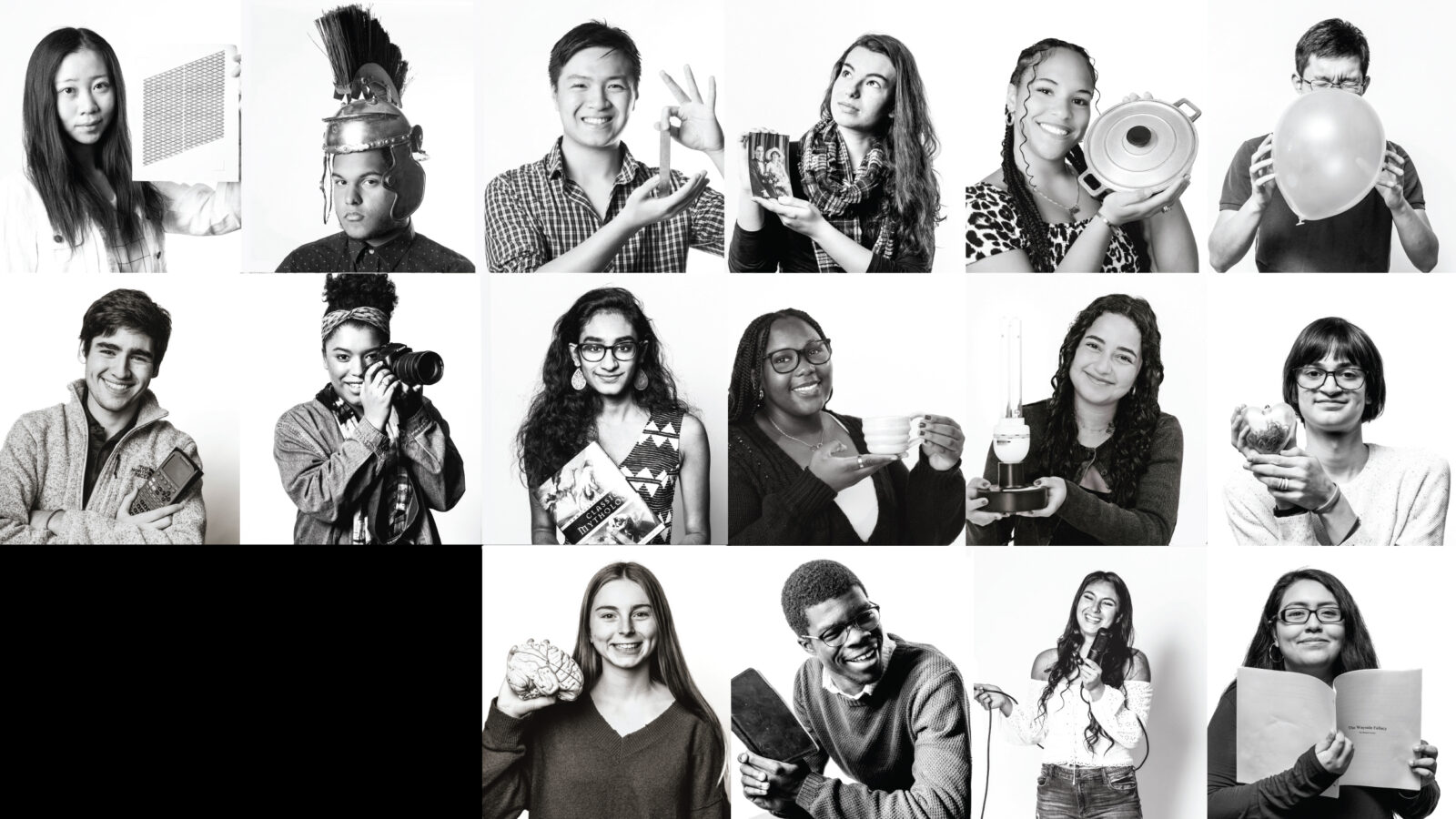
Since 2010, the Williston Scholars program has been inspiring students to pursue their passions while learning college-level research, writing, and presentation skills. In celebration, we surveyed the more than 600 alums who have completed a Scholars project, and on the following pages present some of their thoughts on the lasting impact of this engaging program.
In an era of digitally shortened attention spans and chatbots that provide instant answers to even the most complicated questions, one Williston course that demands sustained intellectual effort and long-form presentation skills continues to grow in appeal. The Williston Scholars program—launched 15 years ago as a trimester-long elective allowing students to explore a subject of their choosing in depth—last year drew a record 64 seniors and juniors who, with the support of peers and faculty, conceived, pitched, researched, developed, and publicly presented projects on a wide range of ambitious topics.
As heartening as the program’s popularity has been for teachers and administrators, Williston Scholars has also had an inspiring impact on its participants, as revealed by a recent survey of alumni whose comments are collected here. Many credit the course with teaching them organizational and research skills that helped them succeed in college and later endeavors. Others say their Scholars topic remains an area of personal interest, shaping their college studies and even their career paths.
“Working on the Scholars project at Williston was a formative experience that continues to influence my studies, career, and personal interests today,” explained Jeremy Dube ’24, a computer engineering student and software developer who together with classmate Joe Zhou ’24 developed an artificial-intelligence–based computer therapist called Empathy Engine. “Empathy Engine wasn’t just a high school project; it was the starting point for my journey into computer engineering, ethical AI, and a career where I strive to build technology that truly matters.” Reagan Joyce ’20, whose project involved choreographing and performing a dance that explored a young girl’s journey through depression, healing, and rediscovery, also found the course profoundly transformative. “Personally, the project helped me learn about myself—how I process emotions, how I connect with others, and how I can use creativity as a tool for healing and advocacy. It laid the foundation for everything I’ve pursued since: a life rooted in compassion, a personal mission to destigmatize mental health, and a belief in the power of storytelling.”
For Williston Scholars faculty—who often serve as mentor, coach, and cheerleader as well as instructor—feedback like that is powerful validation. “I’m a real big believer in the success of this,” says Interim Dean of Faculty Chris Pelliccia, who previously taught the program’s science section. “The student experience is excellent. They can’t sit there and be passive. They’ve got to be active, and the students who get the most out of it are the ones who really dig in.” History and Global Studies teacher Sarah Klumpp agrees. “The kids who find the most reward in this process are the ones who eventually buy into the idea that this is hard work but so rewarding,” she says. “They’ve become mini-experts on their topic. They come out feeling proud of themselves for doing that hard work.”
While the Scholars program requires significant individual initiative, it supplements solitary research with collaboration and community. Over the course of the trimester, instructors guide students through the steps of developing a scholarly project, introducing college-level research methods, and drawing on resources both on campus and from the Five College area. Students meet regularly for peer feedback, beginning early in the semester when they first pitch their projects and continuing right through the final public presentation. (Scholars write and present academic papers, but also develop and exhibit works of fine art, dance, and theater, and present research in science and engineering). Learning to collaborate at a high level is one of the program’s most valuable takeaways, explains Academic Dean Kim Polin. “It’s wonderful to see students learn with and from each other,” she says. “They’re learning to be stronger thinkers and to give constructive feedback, skills that are really valuable professionally.”
Polin notes that the wide range and complexity of student projects can sometimes push instructors beyond their areas of expertise, so the school provides them with supplementary professional development funds “to take a class, an online lecture, or whatever else they feel they need to stay current with projects that their students are doing.”
For instructors like Klumpp, there’s another benefit: seeing students stretch themselves intellectually and personally. “It’s becoming a course that the students want to take because it challenges them,” she says. “Writing a 15-to-20-page paper is not an easy task. And then they have to stand up and present it—not just to their class, but to an invited audience. That’s scary—but also really cool.”
And while students may not realize it at the time, a Scholars project can be the catalyst for later personal discoveries. When she was working on her 2017 Scholars project on women’s fashion in the 1970s, Natalie Aquadro ’17 began to wonder if fashion could be a bigger part of her life, or even her career. “I ended up switching my major in college to marketing,” notes Aquadro, now a fashion buyer. “I credit the Scholars project for inspiring me to look into the industry more, and to follow my passion!”
Scholars Today

Rosie Crooker ’22
Scholars project: Grimm Fairytales: The Original Endings and How the Stories Are Told
Today: Senior at Union College, majoring in neuroscience with a minor in German
“My Scholars project was centered on German language and Märchen, or fairytales. In my undergraduate time at Union College, I have completed a minor in German language studies, including an entire course on Märchen. Having the experience of Williston Scholars enabled me to be more prepared for these college courses, as well as to explore an interest of mine that could not be fulfilled by other Williston courses.”

Jeremy Dube ’24
Scholars project: AI Therapist called Empathy Engine
Today: Computer engineering student at McGill University and software developer
“Working on the Scholars project at Williston was a formative experience that continues to influence my studies, career, and personal interests today. At its core, Empathy Engine was about building an AI that could not only respond to words but also understand and adapt to human emotion. This project gave me my first real taste of what it means to integrate AI into a system designed to help people, and it planted a seed that has grown throughout my academic and professional journey. In my computer engineering studies, I’ve continued to explore the very themes that Empathy Engine introduced me to. The project also shaped how I approach my career in tech. Today, I work as a full-stack software developer, and much of what I do—integrating APIs, managing data pipelines, building interactive interfaces—feels like an evolution of what we started back then.”

Reagan Joyce ’20
Scholars project: Teen Depression and Mental Health Advocacy
Today: Associate at Golin in New York
“My project—a 10-minute dance exploring a young girl’s journey through depression, healing, and rediscovery of joy—was more than just choreography. It was my first attempt to express the complexities of mental health through art, and it sparked a lifelong commitment to understanding and supporting others in their emotional struggles. This passion led me to study psychology in college, where I deepened my understanding of mental health, trauma, and resilience. I later worked in a residential home supporting individuals facing mental health and substance abuse challenges, and I volunteered for the Crisis Text Line, offering real-time support to people in crisis. Each of these experiences built on the empathy and insight I first began developing during my Scholars project.

Cici Yu ’23
Scholars project: Potential Treatment for Type II Diabetes
Today: Student at Barnard College majoring in biology
During my Scholars project, I studied how methionine restriction could help manage Type II diabetes. It was such an exciting opportunity to conduct research in a classroom setting and explore a new approach to a disease that still doesn’t have a cure. That project really sparked my interest in how biology connects to everyday health challenges. Now, as a b iology major at Barnard College of Columbia University, I’m looking forward to conducting more research on this and other common diseases that impact people’s daily lives.

Rachel Goodman ’20
Scholars project: Anxiety Over Time: The Meaning Has Changed but the Stigma Has Not
Today: Clinical research coordinator at the Health Promotion and Resiliency Intervention Research Center at Mass General Hospital
“There are links between my Scholars project and my work today; I am now a clinical research coordinator, and one of my main focuses is on women with cardiovascular diseases who have anxiety. I get to sit in on group therapy sessions that focus on mindfulness in order to teach skills on how to reduce anxiety. I plan to get a doctorate and have a career that focuses on anxiety and depression. The Scholars project taught me the foundation of working on a long paper. I remember sitting in the library going through every book I could find about anxiety, a skill I now call a “literature review.”

Robby Hill ’19
Scholars project: Felony Disenfranchisement in Alabama
Today: Marshall Scholar at Oxford University studying urban history and policy
“My Scholars project explored the contemporary effects of historic racial discrimination. This relationship is one I’ve investigated throughout my undergraduate career. Beginning with the carceral system and prisons, I learned about the legacy of urban policy and housing discrimination—policies that have exacerbated racial wealth gaps and weakened economic mobility. My senior thesis as an undergrad assessed how public infrastructure and housing development in the 1950s and ’60s affected racial demographics in cities. I now study urban history and urban policy more broadly. My Scholars project was my first step into my graduate study and professional path.”
Molly Kinstle ’21
Scholars project: The DNA Game
Today: Master’s student studying molecular biology at University of Padua
“For my project, I coded an interactive game to teach middle-schoolers about DNA replication. I wanted to find a fun way to expose kids to a new area of science, as well as to combine computer science and biology (two of my favorite subjects). Now, almost five years later, I am beginning a master’s degree in molecular biology, and am super passionate about DNA. I’m also still passionate about teaching. During college, I was a peer tutor for multiple biology and neuroscience courses, meeting one-on-one with other college students to help them with concepts they struggled with. I also worked at an online tutoring company and taught computer science to kids ages 7 to 11; in one-on-one meetings, I taught both Python and Java. (I actually only learned Java at Williston, so that was another way this project stuck with me over the years!)”

Natalie Aquadro ’17
Scholars project: Women’s Fashion in the 1970s and How It Evolved With
Women’s Rights
Today: Fashion industry buyer
“When I did Williston Scholars, I knew I wanted my project to be about something I found genuinely interesting so it would be more fun to research and complete. I knew I was not creative or artistic enough to go into design, but it inspired me to look into other fashion-related career opportunities. I ended up switching my major in college to marketing, and geared my course selection toward the business side of the fashion industry. I credit the Scholars project for inspiring me to look into the industry more, and to follow my passion!
Parker Brown ’25
Scholars projects:
- For History: Humanizing the “Inhuman”: The Power of Black American Prison Literature
- For English: Vessels of Horror: A Thesis on Pregnancy in Modern Horror and I’m Living Now: A Collection of Political Poems
- For Visual Arts: American Flag: My View of America through Crochet Flags
Today: Student at Haverford College majoring in English and education, with a double minor in African studies and human rights
“I want to be an English teacher in juvenile detention centers, and I feel all of these pieces express that goal. My history project was an in-depth look at literature in the prison system. My English projects showed how I could both analyze and create literature through political lenses. And my visual arts project conveyed my view on a country that has left children behind bars. The failure of America is a core place of study for me, along with how we can resist it and hopefully change it for the better.”
Lessons Learned
Former Williston Scholars describe the skills, insights, and experiences that have stayed with them
“Williston Scholars was the closest thing to a college course I experienced while in high school. It was fundamental in teaching me time management and how to implement feedback into my artistic works.”—Philippa Berry ’23
“One insight that has stayed with me is that failure is a part of science and life. Although I was unsuccessful in reaching my Williston Scholars project goal, I learned to analyze reasons for failure and learn from mistakes, a lesson that has stuck with me in scientific research and beyond.”—Jack Berrien ’24
“The beauty of the Scholars project is that it puts the student in the driver’s seat. You choose the topic, you design the journey, and you learn not just about the subject, but about yourself. That kind of ownership builds confidence, curiosity, and a sense of purpose. It’s a chance to begin writing your own story—and that’s something every student deserves.” —Reagan Joyce ’20
“Scholars taught me that writing is ultimately about persuasion, and good writing uses a variety of available tools in that act of persuasion. I had loaded the first draft of my paper with statistics, data, and charts; Sarah Klumpp encouraged me to add a human element. I brought in personal accounts from people who had lost the right to vote, and it enriched my writing.”—Robby Hill ’19
“One of the most valuable lessons I took away is the importance of asking for help. Early on, Joe Zhou ’24 and I ran into problems we couldn’t solve by ourselves. Instead of getting stuck, we reached out. We scoured forums, asked questions in developer communities, and even contacted the creators of a product we were using. Every time we asked for guidance, we not only solved the problem but also learned something that we could apply later. In college and at work, I actively collaborate, ask questions, and leverage the expertise of those around me.”—Jeremy Dube ’24
“Williston Scholars definitely prepared me for more independent projects. When I did independent projects in my college courses, I made sure they were on topics I really cared about, and that I would enjoy researching. It also helped inspire my professional career and made me think outside the box.”
—Natalie Aquadro ’17
“The amount of planning and time it takes to write a novel-length story gave me an appreciation for authors I did not have before.” —Nick Kioussis ’13
Photographs by Joanna Chattman and Paulette Griswold