
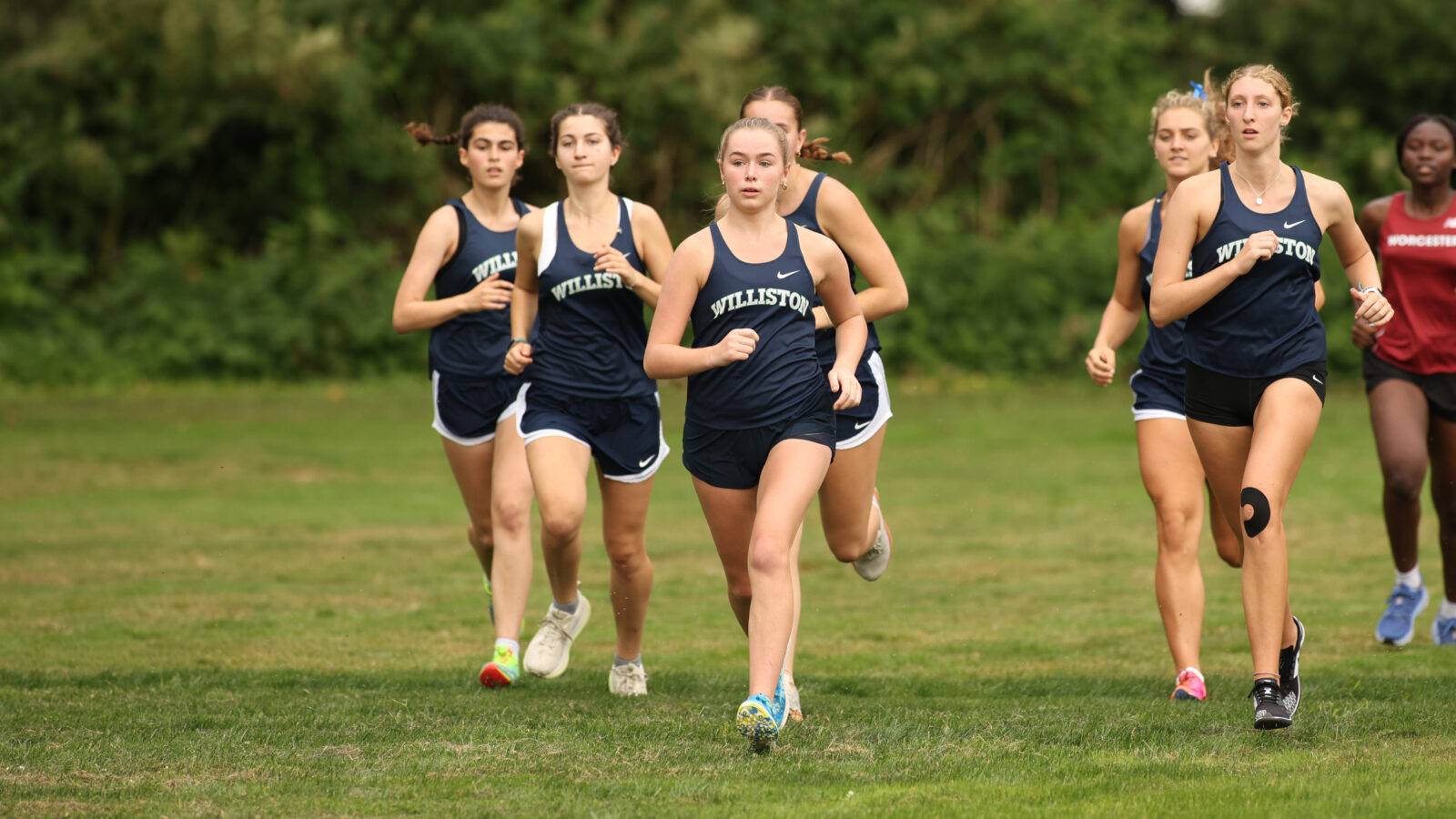
It’s simple, the main issue cross-country competitors have with their sport. It’s straightforward, easily understood, and it’s also nearly universal, and it’s true, and it’s this: running is hard. Fun, exciting, but hard.
Every runner has uttered a variation of that statement, and Williston cross-country captain Francesca Gionfriddo is no different. She said her team is “bonded by the difficulty of running.” She also said, “the running never gets easier, you just get stronger.” Her co-captain, Zoe Simon, summed it up with an understatement: “This is not an easy sport.”
But in spite of this, or perhaps because of it—the motto goes their sport is other teams’ punishment—Williston’s cross-country runners are a unique breed of athlete. Self-driven, mentally tough, fiercely competitive with themselves, and yet at the same time always ready to celebrate anyone who laces up and participates in this physically and mentally grueling pursuit.
In fact, celebrating is part of what brings the team together, and what keeps them going when the next hill looks too steep to climb.
“We celebrate the little wins, like a PR [personal record] or even a first race finish,” said Simon, a day-student senior who has been on the team since ninth grade. “The environment is really supportive,” she said, a culture that’s constantly being built by both coaches and runners. “A hard sport plus a hard social environment would make it not tolerable.”
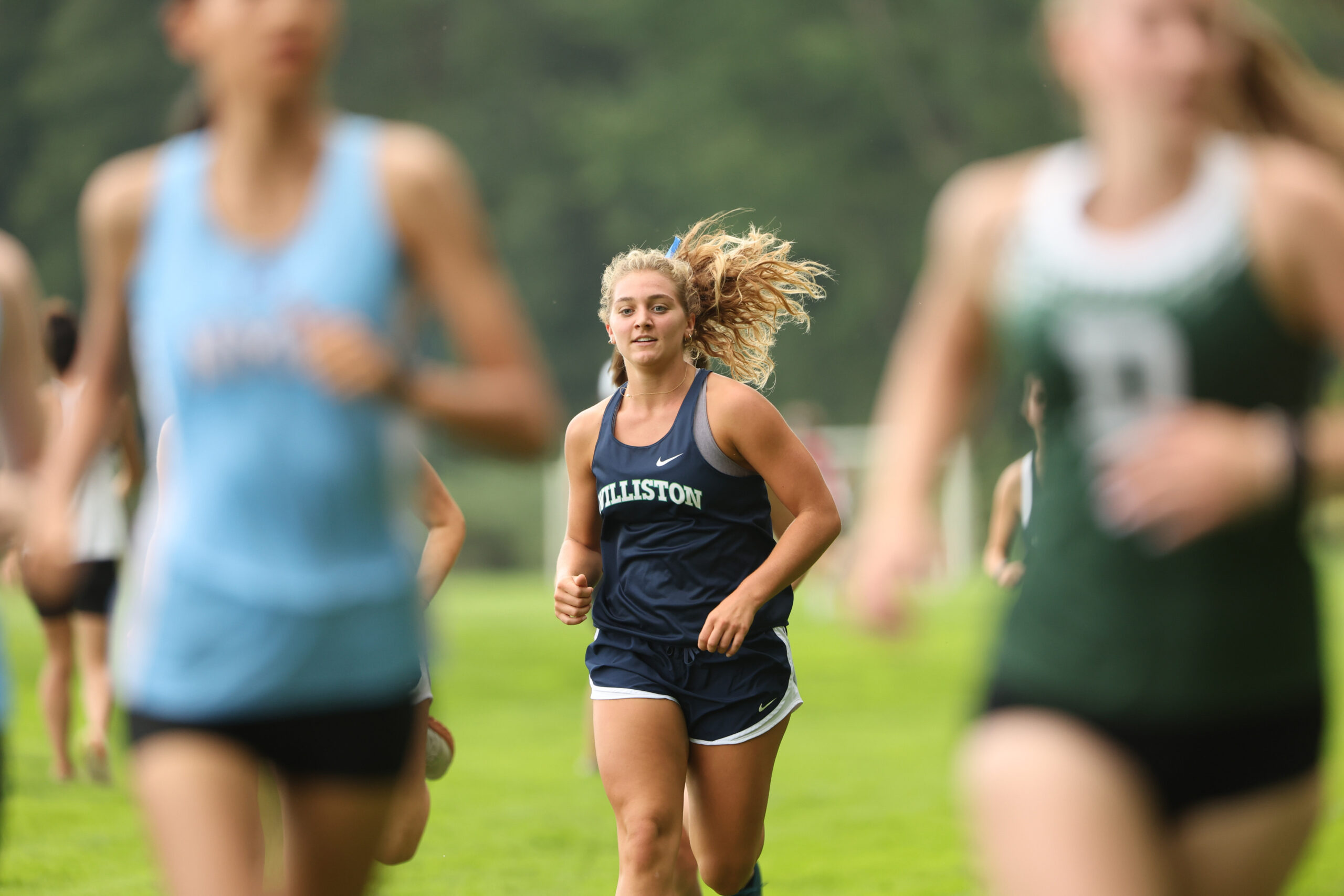
It’s not by accident that both the boys’ and girls’ teams are such strong communities. Every practice, every meet, the runners are figuring out ways to push each other while also keeping things light—at least as light as they can when striving to run as fast as feasibly possible for 3.1 miles against a swarm of other people all trying to beat them.
“It’s a really positive atmosphere, both in practices and races,” said Gionfriddo. To that end, the team intersperses hard training runs, hill repeats, pace work on the track and weekly lifting sessions with runs around the Mt. Tom reservoir and up to Park Hill Orchard.
The girls’ team is coached by Christa Talbot Syfu ’98 and Jessica Tabb Wood; the boys by Michael Doubleday and Michael Mailloux. Both compete in the NEPSAC Class B division.
They blend in silliness as well, with traditions like Friday theme days; a recent ‘80s theme coincided with an aqua jogging pool training during which Gionfriddo pumped ‘80s jams through a portable speaker. The team also has a practice called “Secret Sneaker,” a take on Secret Santa in which runners send anonymous notes of positivity to their teammates.
Because it’s always possible to run faster, Gionfriddo said it can be difficult as a competitor to mark notable achievements from day to day, and that’s where this culture of positivity comes in. “It’s hard to feel accomplished,” she said. “We kind of have to celebrate the little wins.”
As Simon stated, “It’s much easier to go up that hill when there are people cheering for you.” That cheering and optimism, she was quick to mention, is something the team continually works hard to cultivate.
Sarah Martini, the third co-captain with Gionfriddo and Simon, takes leadership cues from her first captains when she was a seventh grader, Anna Richardson ’21 and Poojaa Prakash Babu ’21.
“They were wonderful,” she said, noting that both runners instilled in her the importance of traditions to offset the pain of running and form a cohesive unit of competitors. Those traditions, along with theme days, include scavenger hunts, ribbons which Martini brings to each meet, and baked goods she makes for the team.

Prakash Babu, a recent graduate of Trinity College, remembers that team fondly, and says what cross-country taught her, more than anything, is that she is capable, because she pushed through the pain, of so much more than she ever thought.
“Cross-country is hard and long and more than stamina you need a strong mental attitude,” she said. “No matter how big the hills are … as long as you keep running you will reach the finish line. You just have to keep pushing and something good will come your way. All you can do is make an honest effort and not give up.”
Something good is already coming Martini’s way. She admits that when she began six years ago, said she would “walk to the top of the hills, it was so brutal.” However, at the October 25 Shaler Invitational, Martini ran a PR of 23:08—beating her record by one minute and seven seconds.
Along with the constant battle of pacing and pushing themselves, of trying to beat the course record or just finish the course, cross-country also provides its competitors with a surprising sense of serenity, according to boys’ co-captains Brody Richardson and Casey Muscato, who said he especially enjoys the long, 8-10 mile runs, even more so as the leaves begin to change. “It’s like sightseeing,” he said.
On nature trails, Muscato added, “it’s usually pretty peaceful and quiet,” and he can “zone out or get into conversation.”
Richardson, who runs with Muscato, agrees.
“I don’t think about anything, just breathing and how to stay calm,” he said. “If I’m on a race where I’m solo and don’t have to deal with anyone else next to me, I can get into the zone and remind myself to breathe, take deep breaths, and use the people around me to motivate me.”
Important to know: Muscato and Richardson are zoning out and enjoying the peace and quiet while running 7 to 7:20-minute miles. For upwards of 13 miles.
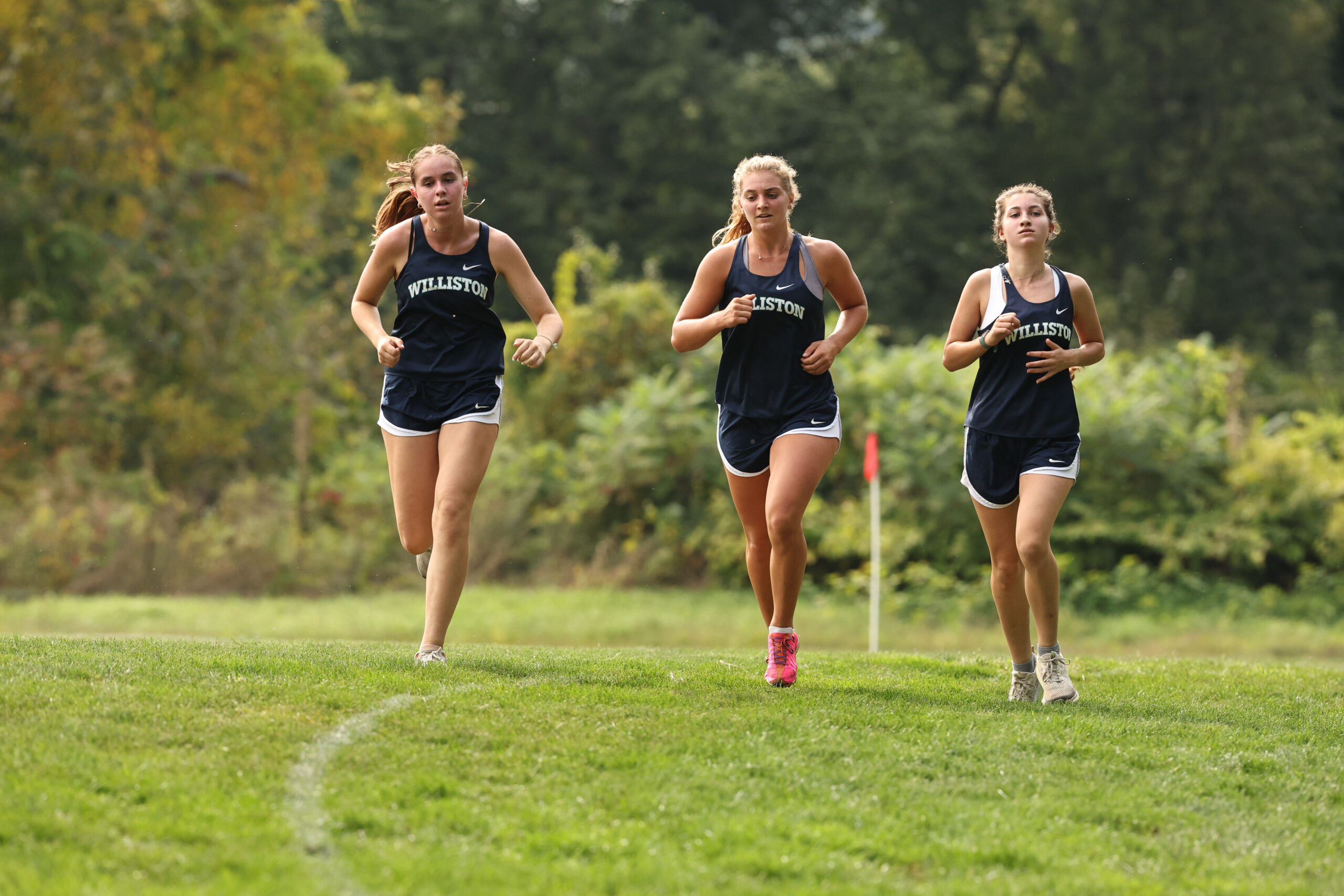
“It’s a very self-driven sport,” Muscato explained. “You can make it hard and get a lot out of it. I’m reaping the rewards of it. I’m getting faster, feeling faster, and being able to go for longer runs.”
Those rewards were on full display on October 4, when Muscato, a senior from Pensacola, Fla., ran the course in 18:18, his personal best. Of course, as he’s done all year, Richardson finished first that meet. And the following one.
And then there was the team’s home meet against Taft, in which Richardson broke his own PR (set the prior week), crossing the finish line in 16:15, the fastest Williston time ever recorded on the Galbraith course. The course record, 15:54 set in 2019 by Loomis Chafee runner Matt Farrell, is a record he always has his sights on.
He wasn’t always this fast, of course. As a seventh grader, Richardson, a day student senior, said his dad has videos that show him looking “like a dying gazelle. My form was atrocious; it was a whole new sport for me.”
But as runners do, over and over, he kept running. His times got faster. His form got stronger. And, as someone who racks up 45-plus miles a week, he could easily take credit alone for his accomplishments. But here, again, is where this sense of community shows itself.
He remembers his middle school teams, and the subsequent ones, as “so closely knit together as a family,” he said. “They included me in my seventh and eighth grade years in after-practice activities, group chats, making senior posters. We all did these extracurricular activities that made the group bond better than any other team I’ve been on.”

Richardson said he looked up to his past captains Will Chalfant ’23, Calvin Klumpp ’24, and Jeremy Dube ’24, and tries to lead the way they did, with inclusivity.
“I try to be a leader not only to correct mistakes, but to be a friend, and make them feel they belong and to motivate them,” he said.
As for the pain?
“That’s what you sign up for,” said Richardson. “That’s what the sport is about. You have to embrace the pain and be almost one with the pain. You train your body to be able to maintain and push through the pain. You’re not going to run a fast time if you’re not hurting. You have to be comfortable being uncomfortable, ultimately.”
Added Gionfriddo, “You have to be willing to push yourself past what you think you’re capable of. We’re bonded by the difficulty of running.”