
Off the bat, let’s squash the equestrian stereotypes. The athletes aren’t sitting, first off. And if it looks like the rider isn’t doing much, that’s because they’ve spent countless hours—about a decade each, in the case of Avery Blumberg ‘27 and Maeve Haber ‘30—making it look easy, learning, practicing, internalizing the infinitesimal ways to manipulate a 1,200-pound animal into doing exactly what they want it to.
Haber puts it more succinctly: “Most people think it’s easy because they’ve been on a pony at a carnival when they were five.”
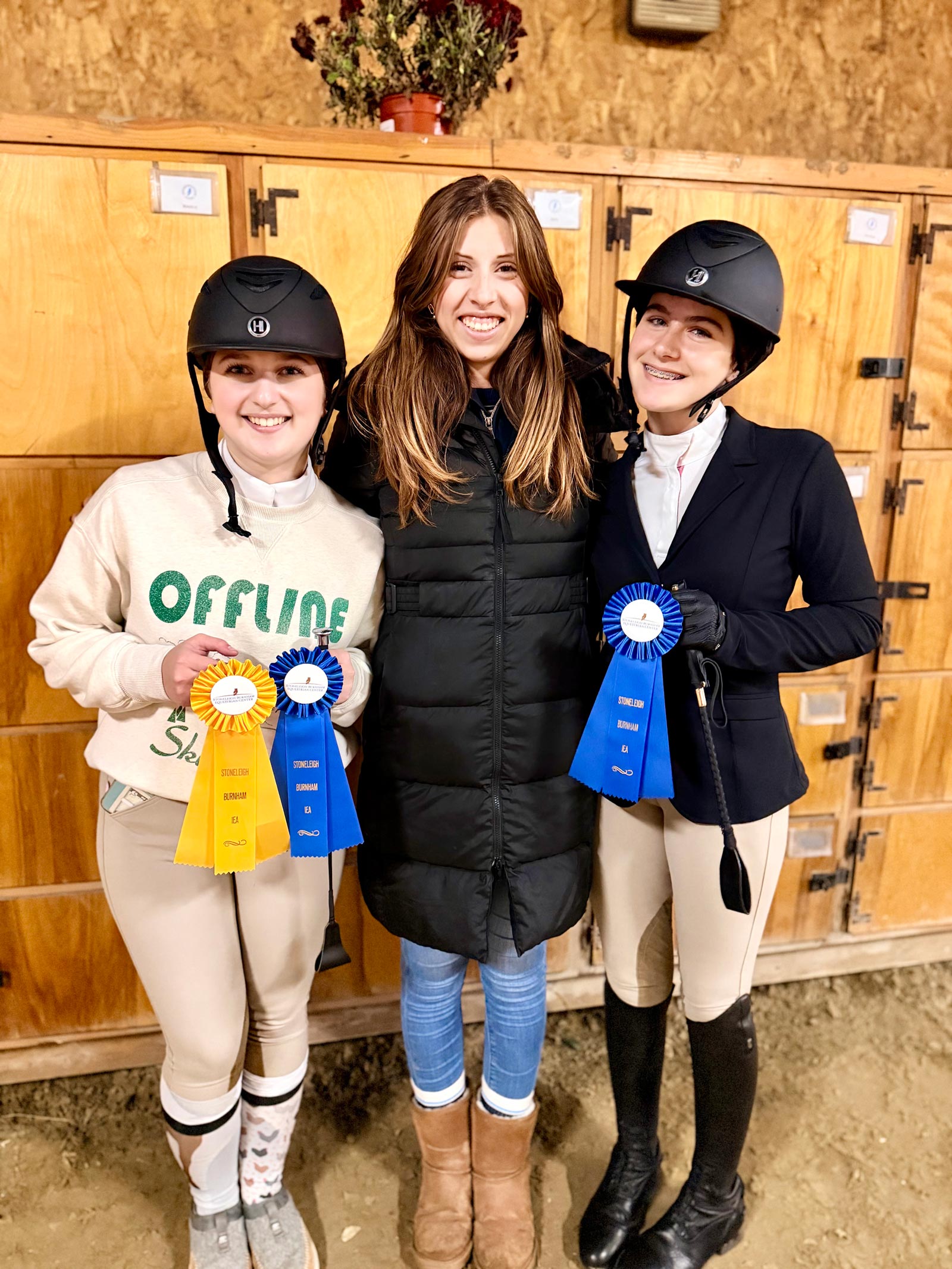
In fact, it’s a sport of extreme precision and intense concentration. Blumberg and Haber have the years of practice and the recent accolades to prove it. As part of Williston’s Riding program, which makes use of the Mt. Holyoke College Equestrian Center facilities, both qualified, at their last regular season show, for the regional competition, which will be held Dec. 19 at Lighthouse Hill in East Windsor, Conn. Blumberg ended the season with a first-place prize in the Varsity Open Over Fences category; Haber too took home a first-place trophy and qualified in the Beginner Walk Trot Canter round.
It’s the culmination, for Blumberg especially, of 11 years or relentless dedication to the sport. But it wasn’t a storybook start for her.
“I loved horses and my mom said I should try riding,” Blumberg, a senior from East Longmeadow, said. “The first time I got on a horse I was petrified and said I’m never doing this again.”
Once she’d been riding a few years, however, her skills, and in turn her confidence, grew. Now, she says, she’ll ride “any horse you put me on.”
That’s a benefit, as International Equestrian Association (IEA) rules dictate riders are assigned a random horse for every competition.
Though Blumberg is sure of her skills, she is quick to admit that her success is due to years of hard work and time spent at various barns in Massachusetts and Connecticut, including Shallowbrook Equestrian Center in Somers, Conn., where she first met Haber when the two attended the same “pony camp.” They’ve been tight ever since.
Haber’s introduction to the sport came with less immediate fear than Blumberg’s—she admits she fell in love with horses the first time she was around them—and the same amount of commitment.
Haber, now practicing at Temple Farm in Hampden, Mass. and from Longmeadow, has been riding since she was five—a third of her life.
Haber is quick to note the subtleties of the sport that fascinate her.
“A horse can feel what you feel,” she explained. “If you’re not having a good day, they know what you feel.”
She’s quick, too, to dispel myths about the sport.
“People don’t know it’s very mental, you need to be in the right headspace, and learn how to [stay] in that headspace,” she said. “You don’t just go and ride … You can hurt a horse if you’re not riding right.”
Blumberg eagerly echoed Haber.
“A horse can feel any sort of balance change you do,” she said. “It’s all about miniscule movements.”
To that point, both riders said there is an extensive warm up period for both horse and rider, which includes brushing the animal, tacking up, stretching, walking the course, learning the routes, and other nearly unnoticeable but important tasks that make up the sport.
Though all these small but crucial tasks go into the sport to make it look effortless, the impact riding has had on both Blumberg and Haber is clear.
Blumberg said she’s learned, through equestrian, that she has a habit of overthinking.
“When I think too hard, I mess up,” she said. “I just have to trust my riding and have a plan.”
The sport, and its particular environment, allows for that.
“It’s an escape,” said Blumberg, who rides about four times a week. “When you’re at the barn it’s a whole different reality.”
Blumberg is quick to credit the juniors and seniors who she looked up to when she was a middle schooler first starting in Williston’s riding program, when the team practiced at Amethyst Farm Equestrian in Amherst.
“They had the best sportsmanship,” she said of former riders Angela Tsai ‘22, Pierceson Squires ’23, and others. “I saw the standard I needed to be” when she would eventually have younger students looking up to her.
Haber said training has forced her to stick to a regimented schedule: if she wants to be well-rested for a day of practice or competition, she has to get her homework done, which means she’s able to focus when she needs to and not put anything off until the last minute.
Despite the tireless dedication—or perhaps as a result—equestrian has also given both athletes long-lasting friendships, including one another.
“The friendships you make through riding are some of my favorite people,” Haber said. Because it’s both her hobby and her sport, “When I tell them something about horses, they understand it. It creates such big bonds.”
There is a beauty to equestrian, both agree, that other sports simply don’t have. These moments make the training, the time, the fear, the focus, all worth it.
“Sometimes you’re out in the woods, riding,” Haber said. “Those are my favorite memories, me on a mountain on a horse with my friends.”