
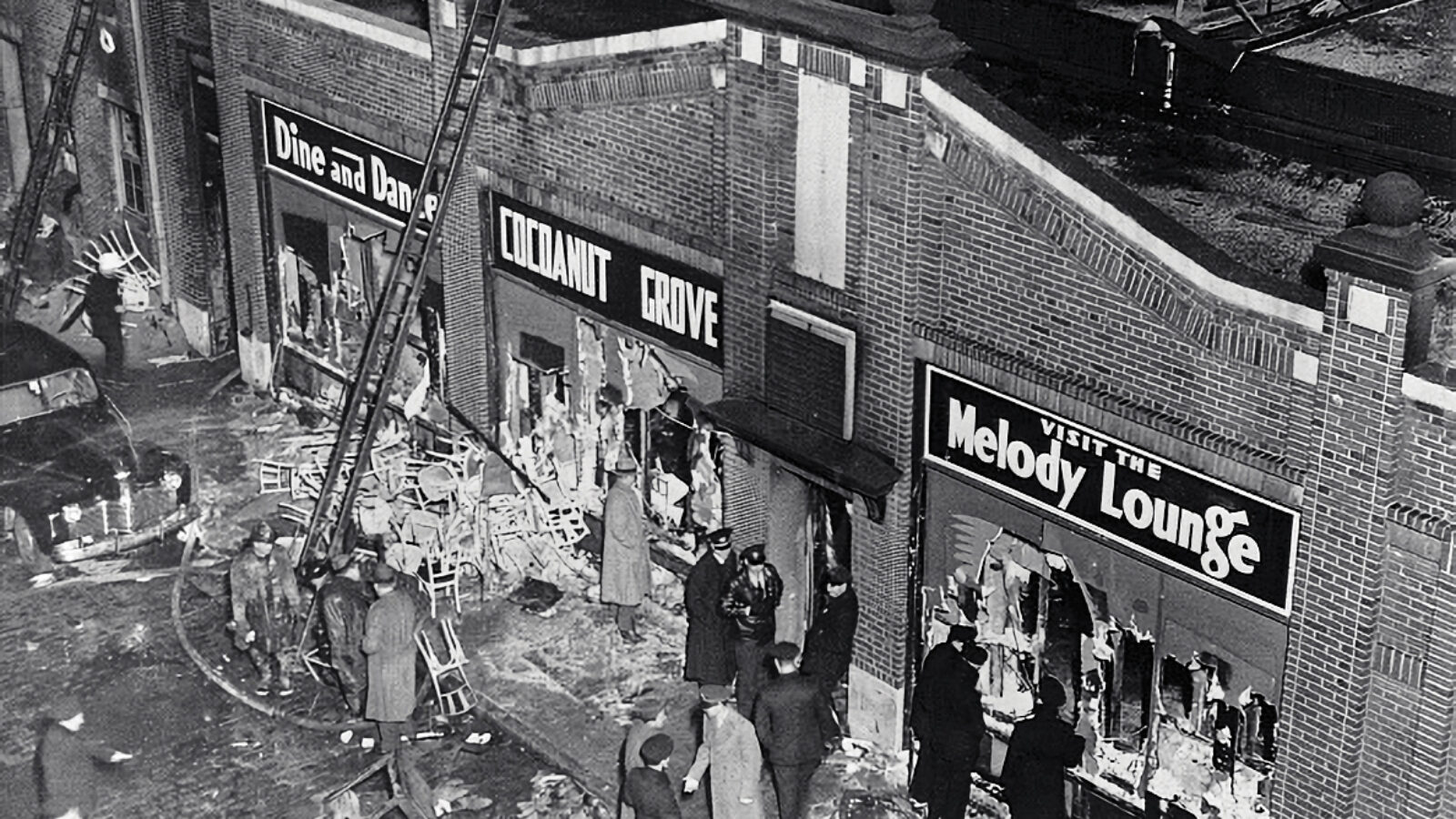
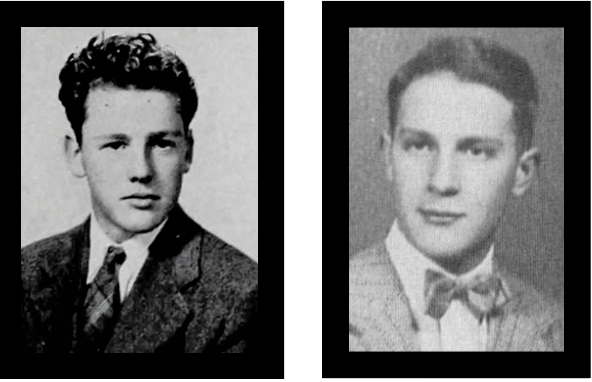
The 1942 Cocoanut Grove fire (above) presaged the horrors that Bob Shumway ’44, left, and Dick Moulton ’44 would see in World War II
One fateful night in Boston, Robert Shumway ’44 and Richard Moulton ’44 survived a deadly nightclub fire
We were saddened to learn of the death of Robert “Bob” Shumway ’44 at his home in Naples, Florida, last June. A World War II veteran, real estate developer, and club golfer, Bob was also notable for being the last survivor of Boston’s notorious Cocoanut Grove fire. The tragic 1942 blaze claimed 492 lives—and led to the development of innovative treatments for burn victims as well as the nationwide adoption of strict new fire safety codes.
Bob and Williston classmate Richard “Dick” Moulton, then seniors, went into Boston on November 28, 1942, for a nationally hyped Thanksgiving-weekend football game between Boston College and Holy Cross. After Holy Cross’ historic victory, the young men followed the crowd to Cocoanut Grove, a popular downtown nightspot. By the time they arrived, the Polynesian-themed club was already packed to more than double its legal capacity—football fans, holiday revelers, soldiers and sailors about to ship out to Europe and their dates. None of them could have known that owner Barnet “Barney” Welansky, concerned about people skipping out on tabs, had locked many of the exits from the Grove’s tiki-lit warren of lounges, dining rooms, and dance floors.
“We weren’t there for too long,” Bob recalled in a 2020 interview. “All of a sudden, something exploded.” The fire started in the basement level and quickly spread across the ceiling and bamboo-covered walls. Within minutes, flames engulfed the entire building. In the ensuing panic, patrons flattened themselves against the few working exits, only to realize too late that the doors swung inward. Bob and Dick managed to escape through a single revolving door in the lobby, pulling several people to safety with them. They spent hours carrying victims to ambulances. The next day, they drove back to Williston.
Faced with an influx of more than 400 burn victims all at once, doctors would go on to develop innovative new treatments, including the use of penicillin to prevent infection during skin grafts, the creation of the now-standard Lund and Bowder Chart for assessing burned body surface, and the use of petrolatum-saturated gauze to dress burns. Within days, Massachusetts passed laws banning inswing doors from public businesses and making it illegal to lock emergency doors. Similar laws were taken up around the country. “This tragedy negatively affects so many lives,” said Boston Fire Commissioner Paul Burke at an 80th anniversary commemoration in 2022. “But it has ultimately saved many more because of the lessons learned.”
After Williston, Bob and Dick both enlisted in the Army and saw extensive action in World War II. Dick, who predeceased his friend on March 19, 2016, became a nose gunner in the U.S. Army Air Corps. Shot down over the Hungary-Slovakia border, he eluded German forces by hiding out in a cave for two and a half months before being captured and held in a POW camp. He went on to receive four Purple Hearts and give a deposition at the Nuremburg Trials. Bob served in the U.S. 89th Infantry Division, the legendary Rolling W, which crossed the Rhine under heavy fire in 1945 and pressed eastward into Germany. In April, the 89th liberated Ohrdruf, the first concentration camp opened by American troops. “I’ve seen plenty,” Bob would say decades later. “The fire was pretty bad, but so was the war.”