
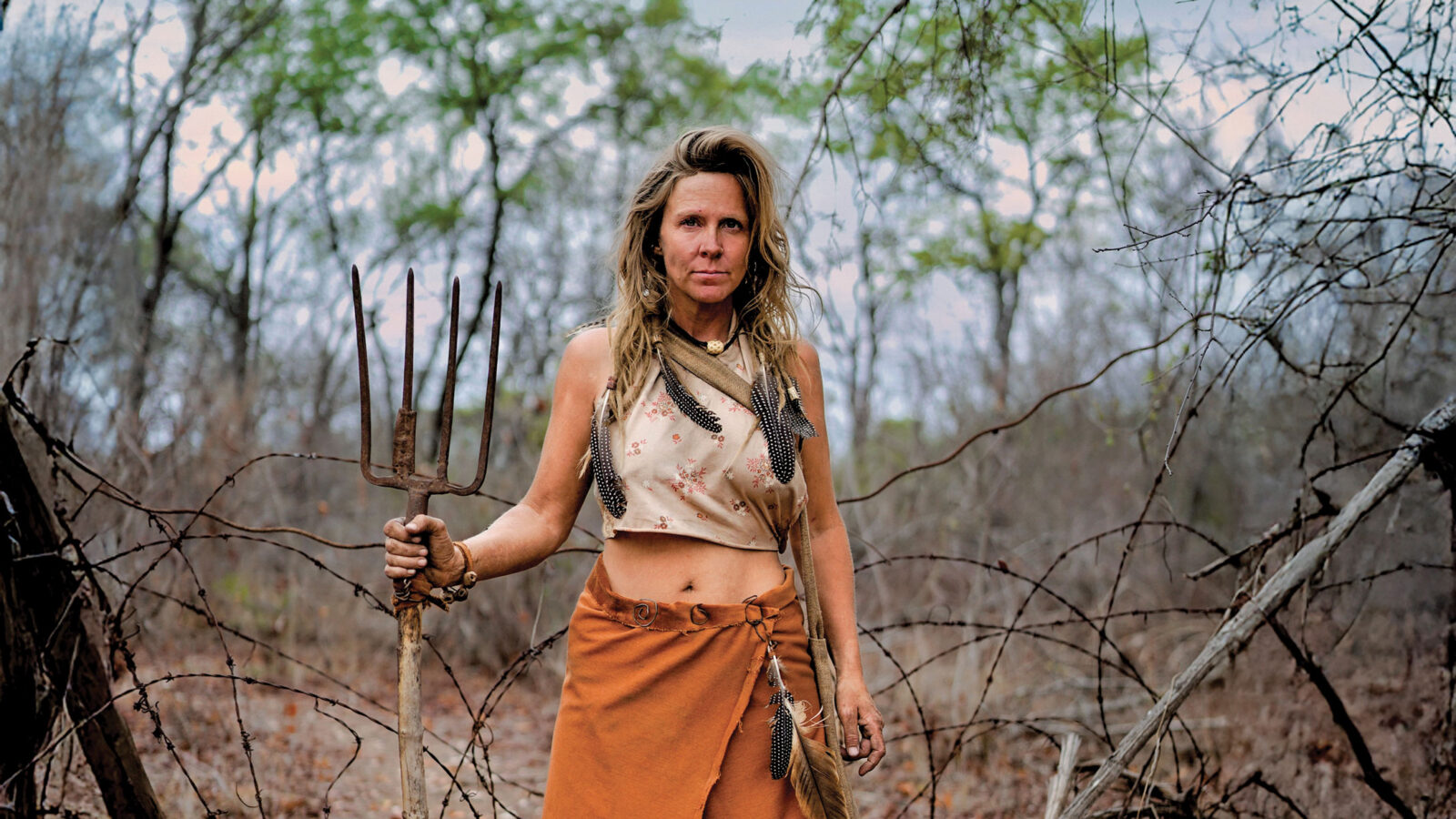
Teal Bulthuis ’01 tested her primitive survival skills on two seasons of Naked and Afraid
It started with a dare. Teal (Kolakowski) Bulthuis’ husband challenged her to apply for Discovery’s reality survivalist show Naked and Afraid. Her first reaction: “That sounds terrible,” she said. “They’re just going to put people in the woods to argue and flip out.”
A primitive-skills practitioner, Bulthuis retired in 2022 as a master sergeant after 20 years of active-duty service in the U.S. Air Force. She now lives in Oklahoma, but she was raised in Topsfield, Massachusetts, with the woods as her playground. After watching the show, she was drawn to the idea of testing her knowledge and self-reliance.
Soon after applying, Bulthuis was dropped, sans clothes, in the middle of the Smoky Mountains in Tennessee, where she met her 2018 Naked and Afraid season 9 partner, Jermaine. The duo had to use their combined wits and fortitude to survive for 21 days.
Bulthuis was pushed to the brink, and yet she also reveled in the challenge—so much so that in 2025 she signed on as an all-star cast member for Naked and Afraid Apocalypse, set in a remote, semi-arid area in South Africa, where she and her teammates spent 35 days living among black mambas, lions, and crocodiles.
During both shows, Bulthuis confronted real fear, and yet her biggest fear isn’t born from the wilds; it’s complacency. “My favorite philosopher is Alan Watts, who said, ‘The meaning of life is just to be alive,’” she said. “If you are constantly living your life in your comfort zone, that’s really the most dangerous risk of all—never trying something that could make you feel truly alive.” We asked her more about the experience.
What does it mean to be a primitive-skills practitioner?
I’m drawn to being self-reliant and self-sufficient. Can you go out into your environment and use the land to make a fire? We are so removed from those skills because of technology. We don’t think about the heater in our car, or the heat in our house, or the AC, or what cooks our food. We just pop something in the microwave, press the button, and go on with our day. As a primitive-skills practitioner, I want to honor the basics of what it means to be human by being able to practice skills that are necessary for our survival.
You’re allowed to bring one item to each challenge.What did you choose, and why?
To the Smokies, I brought a kukri, which is a Nepalese military-issue machete. It’s heavy, and it has an outside edge for chopping and an inside curve for fine work. For Apocalypse, I brought a mosquito net.
What were your reservations about disrobing?
That was probably the easiest part. I was never self-conscious, and I give my parents credit for that. I was brought up with a very healthy body image; we didn’t even have a scale in the house. My mom never talked about my body being anything other than the greatest instrument I’ll ever own. And as such, it’s the best tool I could wish for out there, so I never felt inhibited about it.
On the first day of the challenge [in the Smokies], it was raining and already in the high 50s, so I was immediately cold and wet. You’ve got to learn how to walk in the woods barefoot. I walked about 15 steps before I cut my foot. And I kept that stupid cut on the bottom of my foot for the whole 21 days. The naked part goes out the window so fast because you’re immediately in a slight panic.
What surprised you about the show?
The most underrated part of the challenge is the temptation to save yourself and just quit. It becomes a narrative in your head that goes around and around. In a true survival situation, obviously you don’t have that option.
What were the distinct challenges about each location?
In Africa, the temperatures were outrageous. It got up to 120 degrees, so doing things in the heat of the day was very difficult. Making a shelter was a priority. In the Smoky Mountains, bears were everywhere, and they were super curious and have no fear of man. And in the Smokies, I struggled with the cold. I shivered to the point of muscle contraction fatigue out there naked in the 40-degree weather.
What’s one moment that made you proudest of your own skills?
Hand-catching the crawfish [in the Smokies]. I was thinking outside the box and coming up with a way to feed us. Over the course of our 21 days, Jermaine and I consumed less than 2,000 calories total. After both challenges, I could look back and come up with different solutions to improve our situation, but at the time, you don’t even recognize those needs because your cognitive function declines rapidly without food.
Speaking of food, what was it like eating termites?
In our Western culture, we have a huge aversion to bugs, but globally it’s common to eat bugs because they are the easiest harvestable protein. They’re abundant, and they’re closely related to crustaceans. Seafood delicacies we eat are just bugs in the ocean. I ate a huge spider on Apocalypse. We cooked it up, and it kind of tasted like fried shrimp. In a survival situation, bugs are easy to find, capture, attract, and eat, and many survivalists have favorites. Ants taste kind of like green apple, and termites have a buttery, nutty flavor. You find a log full of termites and throw it on the fire. When the termites start coming out, you grab them and eat them. The last thing I need is my Williston classmates being like, “Oh, the bug eater.” But the truth is, when you’re really trying to maximize what you have available, you cannot discount that protein source.
What did you learn about yourself through these challenges?
Being reduced to literally naked in the wild showed me that I have a resilience that prevents me from giving up—but I did learn that I’m not always happy about it. In the survivalist community, there’s a sense of machismo and boastful capability, with the idea that the people who are uncomfortable and sad tend to tap out (go home). I found that I like being authentic in saying, “I’m not doing ok, but I’m still here.” I have no quit in me, and I think that goes back to my military training. In the military, as hard as things get, you just don’t get to quit. You don’t get to wake up and say, “You know what? I’ve had it.”
What’s your advice for someone considering doing the show?
Go sleep on your garage floor naked, because it’s going to suck. You’re going to wake up every 10 seconds, and your hip bones are going to dig into the cement, and you’re going to be cold. If you can get through it, you’ll be glowingly proud that you did something that your body is literally designed to do. We just evolved into such a comfort-based society that we don’t do that anymore.
How did your time at Williston impact your sense of resilience?
Williston built on the independence that I had started to cultivate by being out in the woods as a kid. I had a lot of freedom, but people were keeping an eye out for me. In a way, Williston is a little like doing the show: independence with a safety net. I could go on an adventure of a lifetime with the fallback of support if I needed it.
40—Total number of days Bulthuis will take on in South Africa’s Zululand in the new Naked and Afraid:Global Showdown, which premiered in May
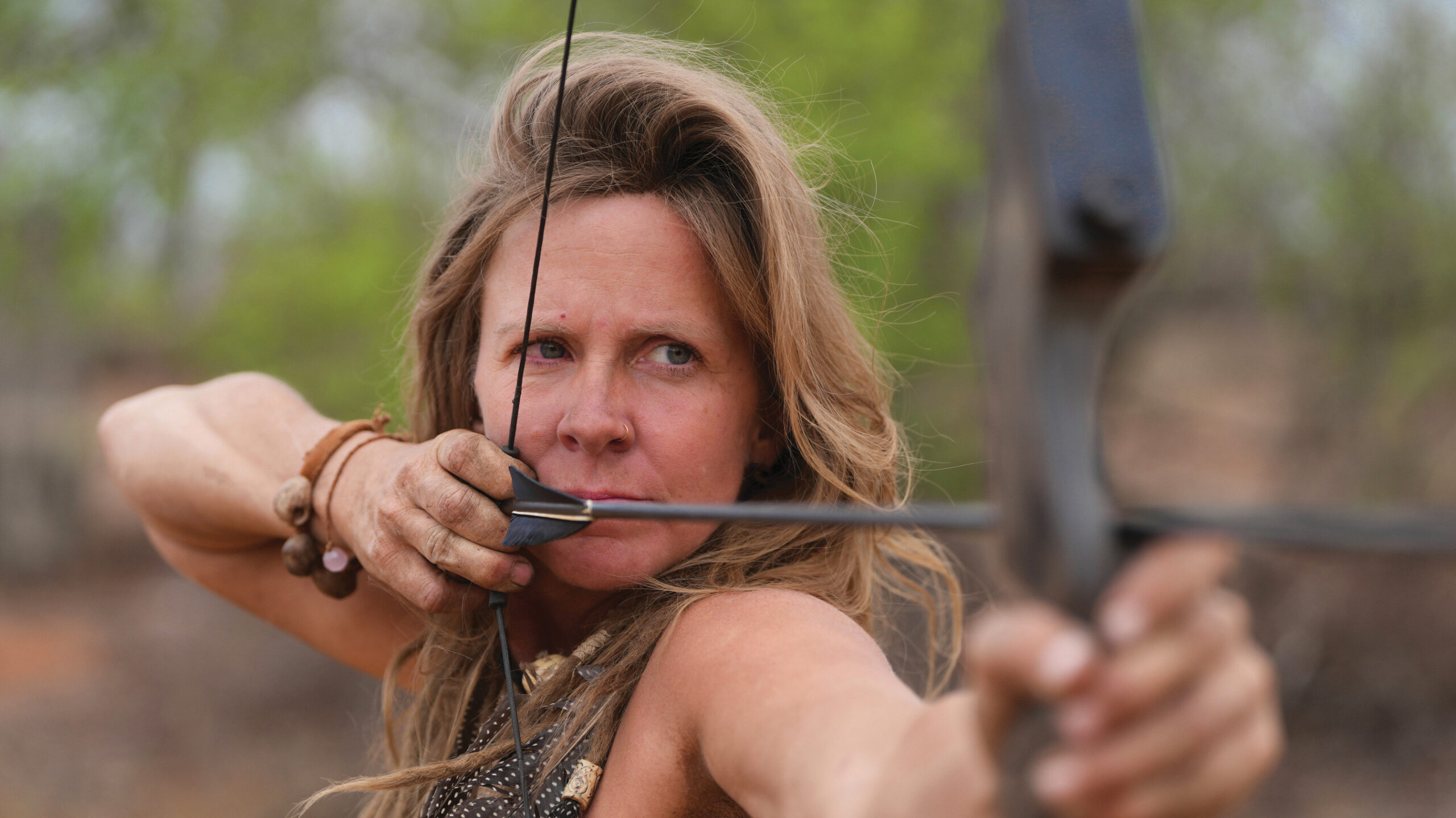
Teal’s Three Essential Survival Skills
1. Find water
Being able to source and purify drinkable water is one of the few things that you can’t delay on in a survival situation. While you may be able to survive up to three days without water, the importance of water is paramount to being able to continue other survival tasks under distress and exertion.
2. Make fire
Having fire coincides with water and purification, but perhaps the most important benefit of fire is body temperature regulation. Without proper shelter and protection from the elements, fire is your number one tool to be able to stay warm and dry. In addition, fire is critical for food preparation, personal protection, and safety.
3. Get comfortable being uncomfortable
The most difficult thing to endure in a survival situation is the raw discomfort. Accepting the discomfort is key; acknowledging your humanness and vulnerability will help keep you grounded and allow you to build courage to overcome the circumstances. The reality is: survival, in the end, is simply about not giving up.