
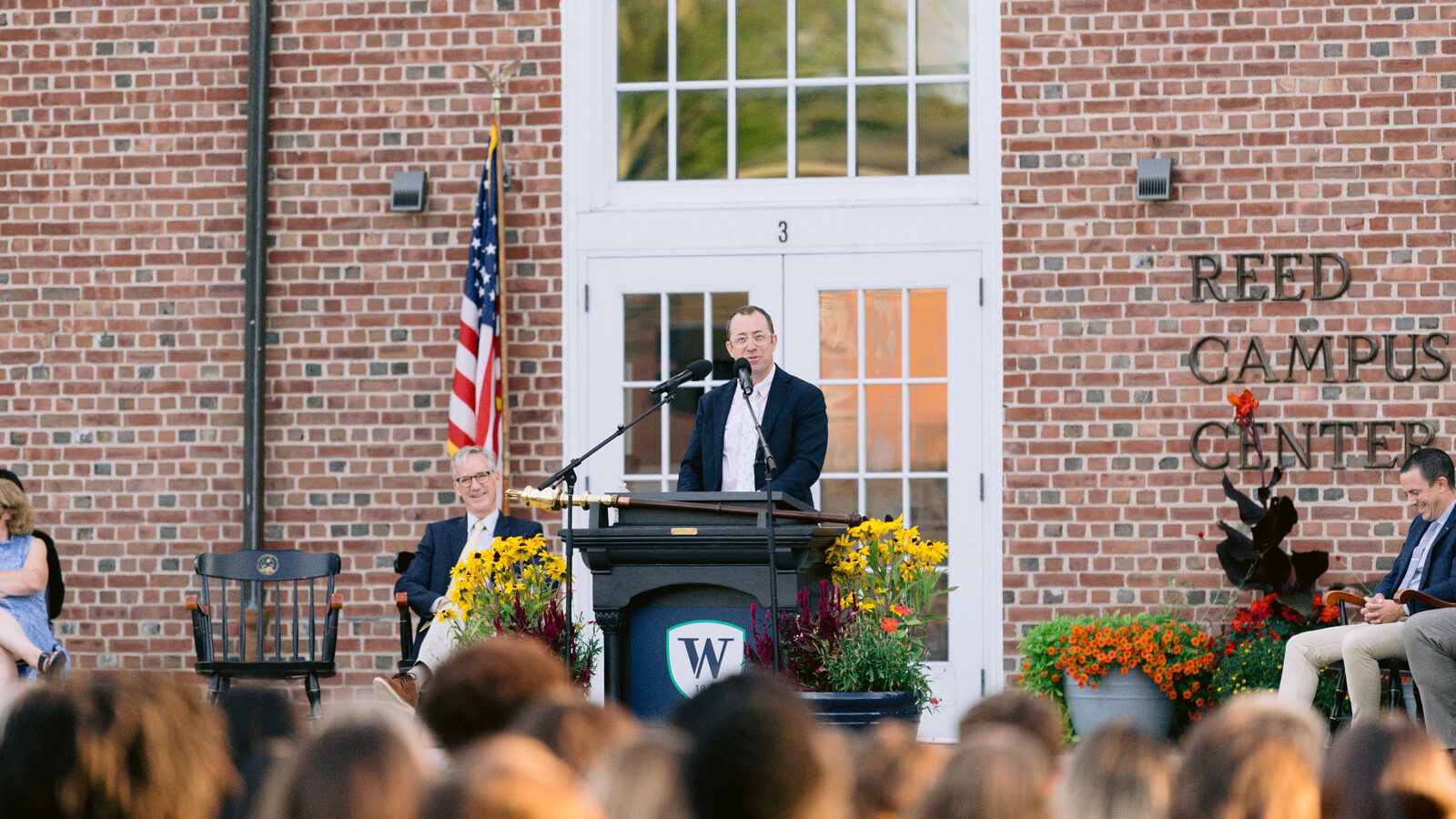
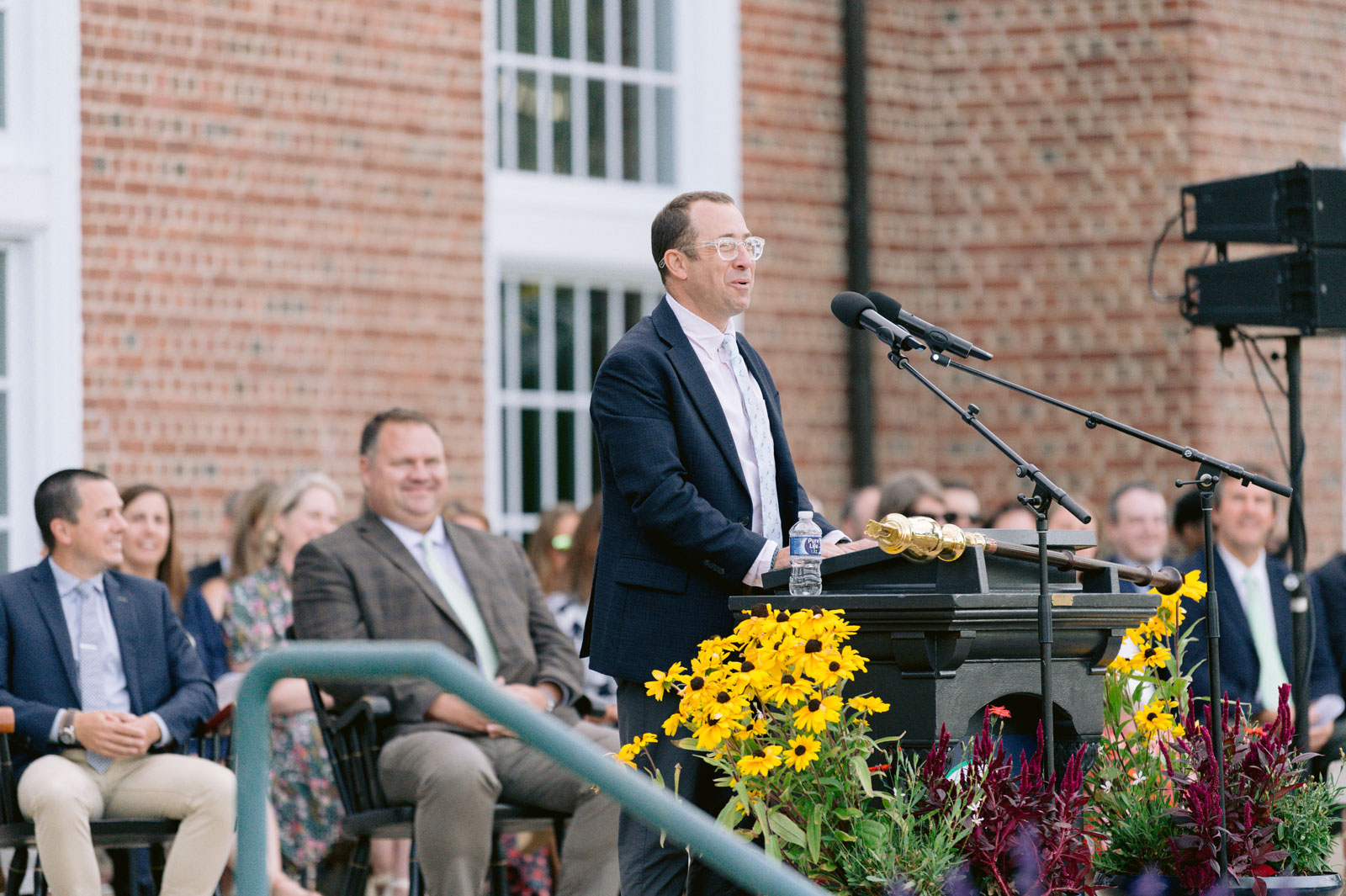
For Williston Northampton School’s 186th Convocation ceremony, alum Seth Kassels ’97 was invited to give the keynote speech. Kassels is the Director of Camp Belknap in New Hampshire, a sleepaway summer camp for boys. As a student at Williston, Kassels gave the student convocation speech in 1996. Below are his remarks in full. Watch the Convocation ceremony on our YouTube page, and see photos from the event on our Flickr site.
It’s wonderful to be with all of you today and to feel the energy of the Williston community.
It’s a great day to be a Wildcat!
I’m humbled to be here and to be asked to share a few words from my own experiences at Williston and beyond and hopefully help set a positive tone for this school year.
I want to specifically thank Bob Hill for inviting me as this year’s convocation speaker. I must admit I have a tough act to follow.
Bob – you have me following the commencement speaker from last year, a fellow classmate, Glenn Jones, who is an Emmy Award-winning journalist. I watched his speech – he’s legit.
All I kept thinking on my drive down from NH today was, no pressure, Glenn speaks publicly on live tv, every day of his life…. you don’t…
So, with that preamble, I do have three stories to share today and some takeaways from each.
Story 1:
It’s the spring of 1996. I’m a junior at Williston. At the time, I thought I had “aura.”
I was junior class president and a three-sport starting varsity athlete. I had been a day student for most of my experience at Williston, but by junior spring semester I needed a break from my parents, so I became a boarder. I was tired of hearing them say, “Remember, this year really matters.”
Juniors, I feel for you, because this year does matter, but then again so does every other year of life.
On one cool, gray day in early May, the walk to Galbraith fields felt impossible. Back then it was still less than half a mile, but in my junior-year brain, it felt like an away game at Tabor Academy – painful.
So, a few of us upperclassmen did the obvious thing; we jumped into a day student’s car, drove up to the field, sauntered over to practice, and still managed to be late.
Our baseball coach, who was just two years out of college at the time and could play ball better than any of us on the team, was Mr. Sawyer, or “Saw Dog,” as we called him, I think to his face, but certainly behind his back. As we strolled into the stretching circle, Mr. Sawyer simply responded with, “You guys have units.” Then he went back to stretching. I was shocked and angry. Practice was a disaster, and the tension lasted more than a week.
Back then, units were Williston’s accountability system: get enough of them and you landed in study hall, work detail, or worse. As I remember, they were much more public because it was before the existence of email. I believe a list of units was somehow posted, and everyone knew, so a public unit really stung.
So why does a rule requiring us to walk to the fields exist? Sure, faculty and administrators are likely to mention liability or insurance reasons. But the real reason is that a community’s culture is not defined only in classrooms, in the theater, or on playing fields. It is defined in the hallways, on walking paths, while in the dorm, or waiting to be picked up at the gym, or hanging out on the quad or in Reed. Culture is shaped most clearly in those unstructured moments. Walking to Galbraith is one of those core Williston community moments.
But also, why did we allow the tension to fester? Because… in my junior-year brain I didn’t ask why the rule existed. I think for Mr. Sawyer, it was simple, we broke a core rule, so we received a unit. He was right on that. I’m guessing he felt the tension, but as a young coach didn’t ask us how we were feeling or if we needed clarity around his decision. Frankly, one unit was not the end of the world, but it became bigger than it needed to be. If someone on the team had acted with agency, by engaging in a conversation on the reason behind the rule, that issue would have been resolved in hours, not weeks.
STORY 2: This one is more of a visualization.
Picture this: It’s elementary school. You are sitting at lunch with your friends. Everyone has brought something different. Someone has Lunchables. Someone has a ham and cheese sandwich. Another one has the classic pioneer valley 5th grade sandwich – organic whole grain bread with hummus, cucumbers, and sprouts. And then there is that one lucky kid who somehow gets to bring a fluffernutter, every single day. Two pieces of white bread with a thick layer of peanut butter and even thicker layer of marshmallow fluff, total perfection, in a fifth grader’s mind.
Every day, someone tries to trade for it.
“I’ll give you two Oreos, half my juice box, and a box of raisins for one bite.”
Your friend just smiles, takes a huge bite, and answers through a mouth full of fluffernutter, “Nope.”
And that is the end of negotiations, every single lunch.
Then one day, he finishes lunch, crushes the rest of his Capri Sun, wipes his mouth with the back of his arm, and heads outside. But what he doesn’t realize is that he just smeared peanut butter and fluff straight up his cheek. As he walks out to recess, what do you do?
Seriously—what do we do?
We can avoid the awkward, embarrassing moment by saying nothing. We can tell ourselves we are being polite. But really, we are letting our friend walk around with fluff on his face because telling the truth feels uncomfortable.
The kind thing is to tell him. Not loudly. Not to embarrass him.
Just quietly, before he gets in front of everyone we might say:
“Hey, you’ve got some fluff on your cheek.” Grab him a napkin and make sure he gets it all. That is kindness. It is honest. It is respectful. It helps.
That is the difference between being nice and being kind. Niceness tries to keep everything comfortable, while kindness cares enough to do what is right, even when it is an uncomfortable situation. And when we are willing to tell someone, with respect, that they have fluff on their face, they learn they can trust us, and our relationship grows stronger, and next time they just might share some of their fluffernutter sandwich with us.
Story 3:
I started at Williston sophomore year because I wanted to do everything: study, play sports, serve on student council, play music, be outside, and be part of a real community. What I did not know yet was that Williston would also teach me how to write.
That happened in 10th grade English with Mr. Thompson. We read stories, talked about storytelling, and wrote an essay every week. Mr. Thompson was a character, so loud, teachers from other classrooms would come in and check on us during class, thinking we were unsupervised because it was so noisy with engagement. When not in class, Mr. Thompson wore cut off t-shirts all year long, a fitting combination with his 80’s-style mullet. Mr. Thompson loved stories. He brought huge energy to class—loud and funny, he was determined to help us find joy in literature and writing. To be honest, I always loved reading, but finding joy in writing was a foreign concept to me.
Each week we were required to write a paper in his class. His rule was simple: earn a B- or higher and you were not required to do a rewrite. Anything lower meant rewriting it the next week. You can see where this is going.
Week 1: D
Week 2: C-, Week 1 rewrite also C-
Week 3: C- again, Week 1 rewrite C+, Week 2 rewrite, C
Week 4: C- again, Week 1 rewrite B (phew), week 2 rewrite, C+, Week 3 rewrite C- again (no improvement!)
Week 5: C+, Week 1 was done!, Week 2 B- also done!, Week 3 C, Week 4 C
That fall, I wrote a new paper every week while rewriting one to four others. It was painful and frustrating. Mr. Thompson was also the football team’s defensive coordinator, so I spent two more hours with him every day at practice. After practice, he would often pull me aside and say, “Have fun writing tonight.” For a while, I thought he was being sarcastic. He wasn’t. He wanted me to find value in the grind: editing, shaping a story, and learning to analyze clearly. I still struggle to love the writing process. This speech, for example, stressed me out for more than a week. But I do appreciate the value of working through a process and the joy of the end result.
At the time, Mr. Thompson’s demands and expectations felt harsh to me, continually grading my papers below B-. But upon reflection, he was being kind. He gave me honest feedback. He pointed out the “fluff” on my face, so to speak. He set clear boundaries and helped me grow as a writer and more importantly as a person.
Today I serve as Executive Director of an all-boys overnight leadership development camp. This is my 14th year working in a community with 300 campers and 110 staff members on a campus far more rustic than Williston. It is completely technology-free. We are so strict around technology, that if a staff member uses a cell phone outside a designated area, they are released, meaning they are no longer employed. No second chances. Campers are not allowed technology of any kind. This may sound harsh, but we all, staff and campers, thrive in this tech-free environment.
What is powerful about a technology-free place is that during down times and transition periods, there is virtually nothing to do but talk with the person beside you. It feels normal sitting on a bench with someone you barely know and asking a question. You have no choice but to be present. That kind of presence is rare. Most of the time in this busy, noisy world, we are distracted, thinking ahead, looking at a phone, or planning what comes next. In class, on the fields, or in the theater, presence is structured. But unstructured presence, listening, engaging, and being ourselves without distraction, is where culture is defined.
That is why we walk to Galbraith Fields: to be present with one another. Maybe a senior talks with a first-year about biology, or two juniors talk about the workload. Those five minutes that provide a laugh, a reflection, a vent, or even quiet, create connection. And connection builds a stronger community.
In closing, I can’t imagine a trickier time to be a student, teacher or administrator in high school. The excitement, availability, and complexity of AI is overwhelming. Should we use it? How should we use it? Is it taking over our brains? What are we telling it to do?
I have no answers on how to navigate high school in the AI world.
But what I do know is if your community’s culture is based on three core components, navigating challenges like AI will be manageable and many times joyful.
So here they are:
First: Have agency and be kind. Say what’s on your mind, with care and intention. Ask the questions you have and speak the truth.
Second: Embrace the process. Keep rewriting those papers. Keep working on relationships. It’s not about the outcome today, it’s about growth through continual work.
Third: Lean into community. The less time you spend on your phone looking at Instagram, youtube stories and snapchatting, and the more time you spend looking at your friends here face-to-face, the more joy you will experience at Williston. The more you put into the culture, the more you will get out.
So, as this year goes into full swing, keep thinking about who you are, not what you do. Work on your values. Choose agency and kindness, embrace the process, and lean into the Williston community. It will give you back tenfold what you put in.
Thank you.