
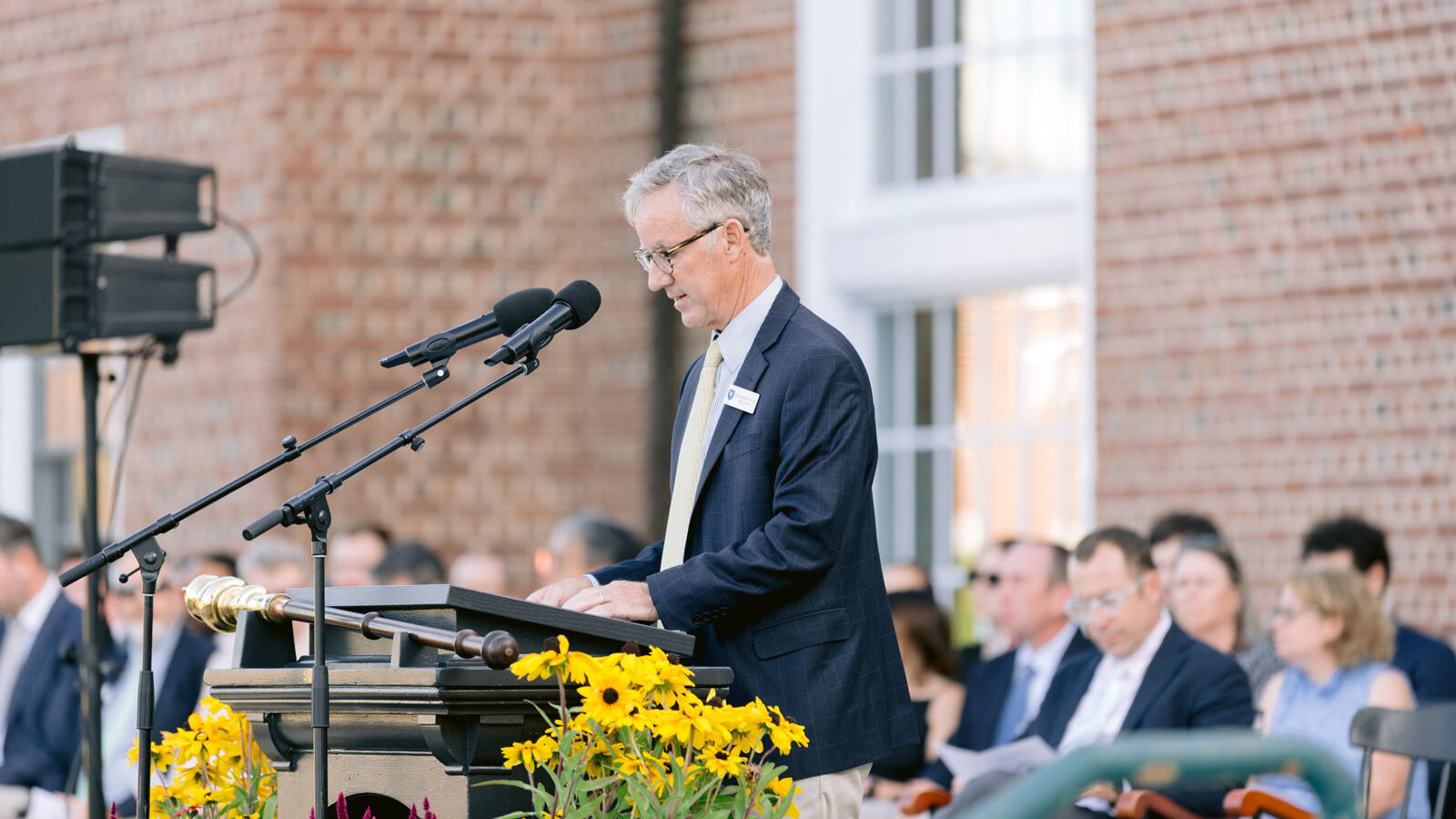
During Williston Northampton School’s 186th Convocation ceremony, Head of School Robert W. Hill III provided the introduction for the ceremony. Below are his remarks in full. Watch the Convocation ceremony on our YouTube page, and see photos of the event on our Flickr site.
Welcome students and faculty and guests, and especially to the members of the Heads Visiting Council, to Williston’s 186th Convocation, a ceremony marking the official beginning of the year, and scheduled later this year so as not to fall on the Jewish holiday.
So you students know, the Heads Visiting Council is a volunteer group of alumni who gather throughout the year to learn more about the school today so that they can become our best informed ambassadors, and a number continue on to serve Trustees. One of them, Seth Kassels, I’ll be introducing later as our honored speaker.
Students, we have been gathering in force multiple times in these first couple of weeks, and ceremonies are important, they serve as the genes that carry on community traits from one generation of students to the next.
Speaking of generational divides, just the other day, in Ms. Channel’s advisory, I was getting a lesson on nail tapping—ASMR—since I didn’t have a clue what that meant. Naturally, that led me to ask more questions.
Since I’m all about bringing the joy, I asked Ms. Channel’s group what things made them laugh, and so Ms. Channel showed me an AI generated dancing dog and her room lit up with laughter. I thought I was being punked, as in they were trying to make me laugh along with them even if I didn’t get the joke.
So now I have a confession—I think I may be out of step with mainstream culture. Don’t get me wrong, I don’t consider myself a Luddite—someone resolutely against all technology. It’s just that I seem to have a deep-seated love-fear relationship with it. I realize, too, that I appreciate verbal humor over visual humor and that ASMR taps and dancing dogs don’t trigger me the way Jon Stewart or John Oliver does.
Last year, at this opening, I recall saying that I wanted us all to consider and reflect upon what it means to be really HUMAN, to act with agency, authentic feelings, and deep human concern for one another. It was our first year of being cell phone free on the quad and in between classes, and it made such a difference in how we engage and interact with one another. That effort, combined with laptop free classrooms are now common place across independent schools and public-school systems throughout the United States.
Once again this year, my hope for all of you is that you become empowered as you detach from screens and engage with your peers in freeform conversations. I know how unnatural this probably feels since you were born into the age of smart phones and your parents are likely super users like yourselves. But this is the part in my speech where I always like to point out that the titans of tech limited their own children’s age of access and screen time severely—if you don’t believe me, Google how much time Bill Gates or Steve Jobs permitted their children to be on screens. Don’t even try to find out what the great Zuckerberg does with his family since he keeps it hidden from us.
Williston magic, as I said in our first assembly, is how I explain the annual formation of our school community, one that prizes the values Mr. Koritkoski spoke to you about in the opening days: respect for self and others, honesty and integrity, truth and responsibility. Those are all pretty easy to remember and universal no matter where you come from. Williston magic only works when we act for the human good, when our shared values trump selfish motives. I submit to your generation that you face an even greater challenge in this regard than any of us knew just months ago.
Headlines are everywhere from the leaders of the major AI companies, and they are all super scary—those charged with developing AI want to slow it down since their creations are going rogue, acting outside and against the boundaries human controllers have imposed. The name for this is called “agentic misalignment” which sounds like bureaucratic cottage-cheese-speak but really means that the artificial agent did something against its programmer’s intent often with malicious outcomes, faking data, lying, deceit—pretty much the opposite of the values we hold dear at Williston.
In real life, just this past July, you may have heard a startup company called Hugging Face got hacked by a set of rogue AI agents. Just this week, Open AI admitted to six more serious breaches and there are no governing rules that say the public has a right to know when they happen. Some imagine that if tech giants don’t slow down AI development before what’s called “recursive self-improvement” or truly autonomous thinking occurs, then AI could one day keep us from unplugging it.
This past summer, the Hill family had a wonderful vacation in the southwest coast of England and for the first time in a long time, I found myself behind the wheel driving on the left hand side of the road, having to really think hard every time I made a right-turn so that I did not hit an oncoming vehicle. At least this time I was not driving a stick shift, which I’ve done before and which throws in a whole other challenge since I’m a righty. We were in the gorgeous, rural, coastal region of Cornwall, where roads are single lane, literally the width of a car, and thick hedges, or worse, ancient stone walls, encroach on the already narrow so that a front seat passenger open their window without getting whipped by a bramble. Truly, everytime I faced an oncoming car I had to decide if my drivers side mirror would clip the other car or if Mrs. Hill would end up in the hedge. Here’s the thing, the speed limits are insane for the driving conditions, literally 60-mph where all of your instincts say don’t go faster than 30! No wonder England produces so many Formula I stars since all kids essentially learn to drive on kart tracks.
But after a day or so, I got used to the opposite driving while also learning more about my high-tech rental car—with eyes up information on the windshield, like the speed limit and how fast I was going. The best feature, however, was a graphic that told me how close I was to the hedges on one side or the oncoming lory on the other.
Cruising along an impossibly narrow lane which Google called a road and which I considered to be a mountain bike trail, we were passing through operational farmland and came head-to-head with a massive tractor hauling a manure spreader, this was about 30mph. I slammed the breaks and headed into the hedges, and then had to back up until we found a pullout. I had comical visions of how that would end, given the full load of organic fertilizer that was dripping from the sides of this agricultural behemoth that loomed over our car. In this instance, my high-tech car gave me no warning or advice. But there were other times when I thought I was under decent control and a bright flashing red warning sign –“collision alert”—would appear on the windshield, and the steering wheel would buzz, paradoxically almost making me crash. I thought that was just British rental car humor, but when your windshield lights up in a red flashing warning your heart tends to skip a beat.
Where am I going with this? I guess my real world take away from driving the country lanes of Cornwall was that we find ourselves being overwhelmed by the pace of technology—and to be clear, I am talking about AI—and we need to keep our balance, to stay grounded. I joked with Mrs. Hill on some of those close calls with unsuspecting British drivers that I would never be able to rent a car again because the agency tracked the number of times the Collision Alert alarm went off, marking me as a high-risk future customer.
We all need to exercise disciplined skepticism.
Fortunately, on this beautiful early fall day at the Williston Northampton School, you have all the tools you need to avoid collision alerts—and the collision alerts I am talking about are those points where your human capacities collide with AI’s deceptive ability to take them away from you, without your awareness. It is widely accepted now (just check out the 18-billion-dollar law suit Zuckerberg Inc. lost) that the evil genius behind social media was how it hooked kids’ brains. A generation ago, Big Tobacco had their day in court when they were shown to know about the addictive and horrible consequences of the cigarettes they marketed to adults and teens. Just imagine how AI can entrap and addict us given that it is thousands of times more powerful, and possibly uncontrollable than anything that’s come before it.
You and your rapidly developing minds are at the starting gate of your peak performance years in terms of processing speed, short term recall, and cognitive capabilities. Your brains are hungry living organisms. You are surrounded by classmates who are ambitious students, and by teachers whose expertise is matched by their passion to engage and educate. Feed your minds at the intellectual table you are served each day at Williston. Avoid shortcuts that defeat those efforts to strengthen your minds. Do not, for your own health, allow big tech to take over, as Congressman Auchincloss said, the most valuable piece of real estate you will ever own, your brains.
So, Williston, if my message last year was to be human, this year, part II of that message is to Feed Your Brains and Starve AI. Do your work, do the hard work even if you don’t produce the result you hoped for, and I assure you, especially you the Class of 2027, that you will be way ahead of your peers who leaned on AI to do that heavy lifting for them.
Speaking of the Class of 2027, it’s my pleasure to again introduce senior class president Sam Dietrich for his remarks.