
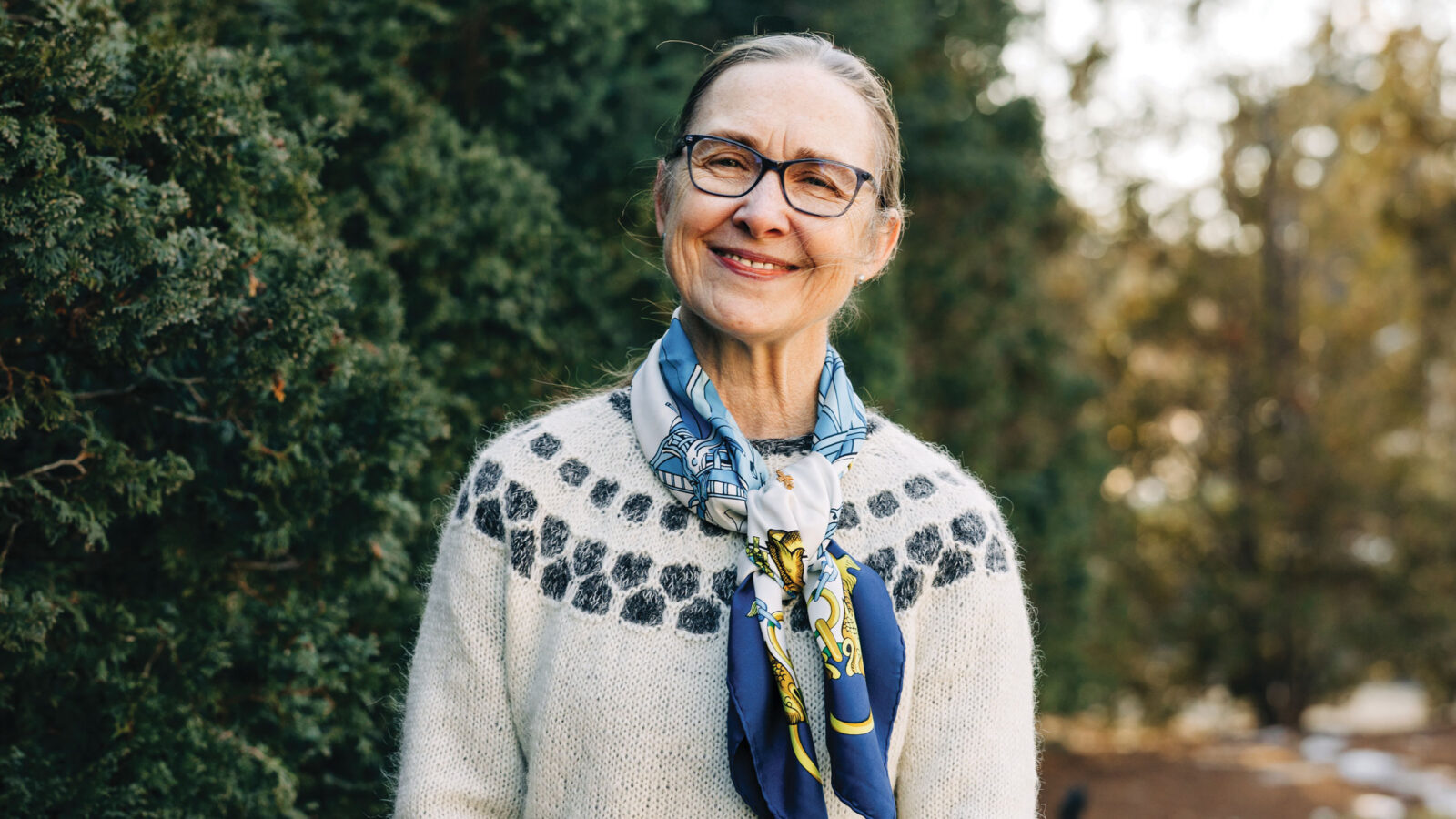
In her early days at Williston, mentorship was a revelation for Lori (Alexander) LeBas ’77. She turned that experience into the guiding force behind her life’s work.
When Lori (Alexander) LeBas ’77 arrived at Williston in January to deliver the keynote address for the Cum Laude Society induction, it was her first time back on campus in 40 years. Even though she’s an Executive Vice President at the Walt Disney Company who’s given presentations all over the world, this speech took her draft after draft.
What was it like to be back?
“It was surreal to sit in the chapel,” she says. “Very emotional.” She looked around, remembering exactly which rows she’d sat in and who her row monitors were. “I could almost feel, there in that moment, what I believe was the core of the me that was very much shaped during my time at Williston.”
As a child growing up in Easthampton, LeBas was determined to go to Williston. Her parents, who married very young, did their best, but LeBas was precocious. She did a lot of her own raising. “At some point, my mom even said to me, ‘I was afraid of you. I didn’t know what to do with you as my child,’’’ says LeBas, a little wistfully. “When you have a baby at 17—versus you’re thinking about going off to college at 17—that’s a very different world.”
At Williston, she found adults interested in her for her own sake. “And not that they expected a payback,” she says. “The reward for them was seeing me happy, succeeding, and growing. Or if I wasn’t, they wanted to know what they could do to help. They were invested in making sure I had the best experience possible. That was completely new for me.”
In her keynote, LeBas paid homage to Rick Francis, Doc Gow, and Yves Couderc, teachers who helped her recognize her strengths as a curious learner, the kind of student who asks questions and tries to find ways to improve. “You are all leaders, challenged to do your best and guide others to do the same,” she told the students in the chapel. “‘Be Yourself Here’ isn’t just a phrase. The self-confidence and courage I gained at Williston are cornerstones of who I am.”
LeBas and I had never met before, but I’d been an executive at Disney, too, overlapping with her in the early aughts. She currently runs operations for Disney’s platform distribution group but has led operations for different teams at the company for more than 26 years. “I work out of Bristol, Connecticut, on the big ESPN campus,” she explains, “but I have teammates in New York City, Greater LA, and now in Europe, the Middle East, Africa, Latin America, Asia, and the Pacific regions. So, I happen to be based in Bristol, but I am more of a …?” She trails off and smiles. “I’m a Disney employee.”
She has a reputation in her industry—and a shelf full of awards— for being innovative, which isn’t a surprise given her success at one of the world’s most creative companies. Another aspect of her reputation, though, is not one I’ve come across before. She’s well known for having mentored hundreds of employees over the course of her career. And for being kind. Kind! I jumped at the chance to meet her.
LeBas talked to me from the home she shares with her husband, Sean, a retired attorney, in the quiet town of Portland, Connecticut, which sits along the Connecticut River. She actively manages her work schedule to ensure her job doesn’t swallow up her life, a trick for every executive. She’s a certified yoga instructor, drawing on it for peace and strength, and makes frequent trips to Sweden to visit her son, Konrad, and get in playtime with her five-year-old, granddaughter, Ylva.
When you talk to LeBas, she leans in, nodding as you talk. When she replies, she uses your name. She has a gift for making you feel that whatever you have to say is important. I start with the basics. “Despite all my years at Disney, I don’t understand what you do. What exactly does ‘platform distribution operations’ mean?”
“So, this is my cocktail party ‘tell me what you do’ answer,” she explains. “Any time you watch content from the Walt Disney Company—whether you’re launching the Disney Plus app for a streaming service, or turning on your television to watch ESPN—my team has gotten that content from where it originated to where it needs to go for it to be able to get to you.”
Certainly, she thrives at Disney in part because of that same curiosity she exhibited at Williston. She’s a true “ops” person, happiest when wearing many hats and fixing problems her colleagues might overlook (or prefer not to notice). “I really only ever interviewed for one job, and that was the first one I got hired for,” she says. “But if I think about how many different roles I’ve played, it’s easily 10, if not 15. I ask myself, where can I go where it’s expected that you’ll raise your hand and take on new responsibilities and want to continue to develop and grow?”
“So, how did the importance of mentoring enter your life?” I ask.
“I can tell you with absolute certainty,” she replies, “and some of this came out in my Cum Laude speech, that I started to understand the benefits of having mentors when I was at Williston.”
When she looks back at her transition to college at Mount Holyoke, she can see the change, how she started observing people and listening for signs that they needed support. It evolved into the mentoring style that has defined her life. “‘Are you struggling a bit here? Is there something that I could do to help you?’” explains LeBas. “‘Is there a way I can hold up a mirror to let you see what’s going on?’ Because I think the best mentoring isn’t telling people what to do. It’s finding a way to help people see what they can’t see for themselves.”
For LeBas, mentoring isn’t a formal program organized by a corporate office—though those can work, too. It’s a series of conversations and connections, often with members of her own team. “Hundreds of people have provided me opportunities to mentor—in a moment, in a meeting, over the course of months and years,” she says. “And to know that my listening and being kind might be just the thing that person needs right then? I put that in the mentoring bucket.”
“To me, it’s saying, ‘My door is open. You want to come in and have a chat?’” she continues. “It can be intimidating for some people even if they understand, ‘Oh, mentoring is just grabbing a cup of coffee to find out what somebody does.’ So sometimes I need to be the person to reach out. I try to reinforce the message that we’re going to have a relationship if you want that. For some people, 15 minutes feels like 15 hours. But for others, it’s opened the door to all sorts of conversations. ‘I’m struggling with my career.’ ‘I’m not sure what to do next.’ ‘I’m a working mom. How did you manage that?’ It doesn’t always have to be about where the next step is up the ladder.”
Peers describe LeBas as both candid and kind. “I think the most important thing anybody can do as a leader, especially in the world right now, is treat people like grownups,” she says. “Just today, I was talking to one of my former team members who got promoted. She was telling me, ‘I want to make sure my people are happy. I don’t want to make these org changes because they might not like them.’ I told her it’s not your job to make people happy. It’s your job to give them the tools, feedback, and coaching they need, and to make sure their responsibilities are clearly defined. Do the things you need to do as a leader.”
“You have to be kind enough to listen to what people’s concerns are,” LeBas explains, “and honest enough to share what you know. Be candid about what you don’t know and share the things they might not want to hear. They deserve the information they need to make the choice: ‘This is the place for me’ or ‘It’s not the place for me.’ Don’t get caught up in mentoring as a hierarchical thing, like ‘I’m the oracle who’s expounding my wisdom.’”
I’m curious to know what’s changed in corporate culture, and what hasn’t, so I ask her if there’s a challenge—something that’s a near constant—that she hears from mentees?
“Yes. I keep getting feedback that ‘I don’t have executive presence.’ I hate that. What does that even mean? And are only women hearing that? Because they’re the ones coming to me. What is this nebulous ‘executive presence’ thing? The sad thing is, whenever someone gets that feedback, they never get examples to help them understand what to do differently.”
Earlier in her career, LeBas got that feedback from her own manager. When her team was at an offsite with an executive coach one weekend, she took him aside, explained the situation, and asked if he would observe her and recommend an action she could take to remedy it. At the end of the weekend, they met again. “I know what the problem is,” he told her. “It’s not a question of what you say. It’s a question of when you speak—when you get into the conversation.”
LeBas, the only woman on a team of mostly high-powered salesmen, was indignant. She replied that she listens to learn and was not someone who speaks just to hear herself. The coach replied, “You asked me to tell you what to do. If you want that feedback to go away, you’re going to have to do your homework in advance and speak in the first five minutes of the meeting. It’s not important what you say, but you need to get your voice heard early. After that you can speak whenever you want.”
“So I did my homework,” says LeBas. “I’d come to the meetings, I would always speak in the first five minutes, and I did this consistently for a month. And then my manager came to me and said, ‘I don’t know what you’re doing, but your contributions in these meetings are just amazing.’”
We both start laughing.
“There’s a whole industry giving mentoring advice, isn’t there?” I ask. “Do you hear people getting advice that you think is really off the mark?”
“Oh yes,” she replies. “Don’t have pictures of your family at your desk. It looks like you’re less committed to your work.’”
“‘Don’t talk about your life outside of work.’”
“‘Be the last person to leave the building.’”
“‘The only way to get ahead is to work harder than every other person.’”
“Of course you need to work hard,” she adds, “But I mean, those are just unrealistic pieces of advice—platitudes anybody could rattle off. I think bad advice comes from people who look at the person sitting across from them only through their own personal lens. ‘Well, if I was in your shoes, this is what I would do…’”
Knowing how hard it is now for people just starting out in the workforce, I ask her what advice she wishes our generation would stop giving young people.
“‘Just get your foot in the door,’” says LeBas. “‘Even if it’s something you don’t want to do, get in the company and then you can move around.’ These days that’s not an easy thing to do. Or ‘Just ignore the culture. Even if it’s a toxic environment, don’t worry, you can still figure it out.’ Well, if that’s the environment you’re starting out in, that becomes normal for you. Will you pass that normal on to the next people?”
So, what does LeBas get from all this mentoring? “When I’m talking to people in different departments, I build a network across the company and beyond. If you can make a call to your friend in finance and get an answer in five seconds, versus taking five hours to research it yourself, guess who’s going to get more done? People I work with believe that they can ask me any question, and I’ll know the answer. That isn’t true, but I will probably be able to figure out who I can go to to get the answer.”
Personally, LeBas loves to hear people’s life stories—a big benefit of mentoring. “When you hear what others are doing you wonder, ‘What could I learn from that? What’s it like to be that person?’ We all bring something different to the mosaic that we’re creating together.”
As our conversation comes full circle, LeBas generously offers to give me additional time if questions arise as I start writing my article. We’ve enjoyed talking about the people we both knew at Disney, and I’m sure I haven’t hidden that I felt inspired to meet an executive who is technically accomplished and emotionally perceptive, all at once. It’s no wonder she was able to make so many connections about her experiences across 50 years. “It’s a mind-bending experience,” she says, smiling, “to come face-to-face with a place that was so much a part of shaping who you are. As I’ve told many people over the years, I left Williston feeling like I have a karmic obligation to do that for other people.”
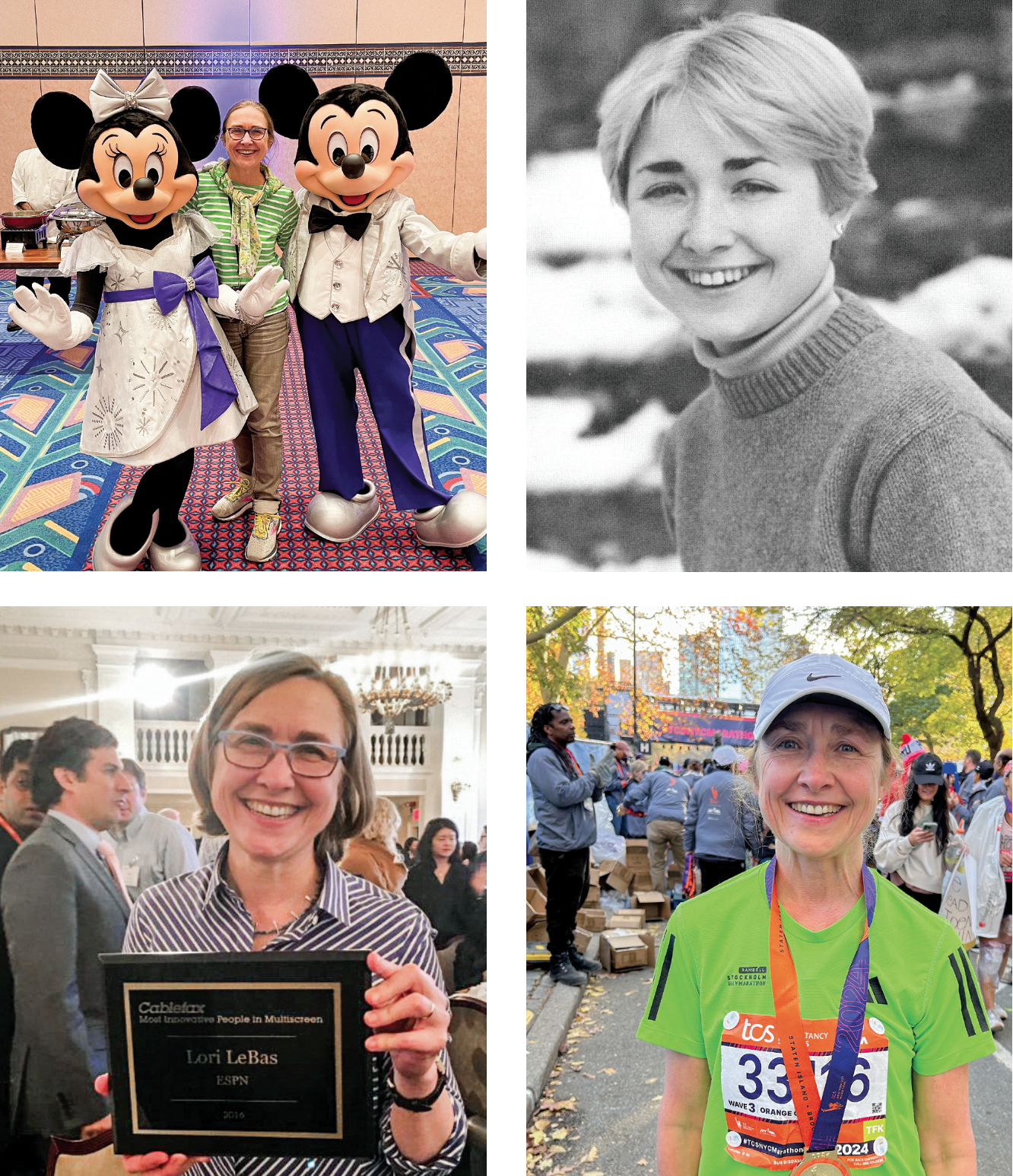 Clockwise from top left: LeBas’ Disney career started at ESPN under legendary ESPN President George Bodenheimer. “His superpower was having employees believe, literally, that they were owners of ESPN”; LeBas’ 1977 yearbook photo, which was accompanied by the opening line of a John Donne poem, “Go and catch a falling star”; LeBas started running marathons at 55 (and has run six!); LeBas with one of many industry awards for her leadership. “At the highest level, mentoring is about helping humans be the best they can be in whatever environment they are in.”